

/PairaVoice-Start-A-Conversation-nobg-md.png?width=200&height=300&name=PairaVoice-Start-A-Conversation-nobg-md.png)


















.png)

.png)


 ChatGPT
 Google AI
 Perplexity
 Claude
 Grok
GrokMost healthcare organizations already have rules for who can access PHI, where it can be stored, and which vendors are allowed to touch it. AI translation tools don't automatically follow those rules. They sit outside the systems built to enforce them, which means a translated message can leave PHI protections behind even when the original message never would have.
This is easy to miss because translation feels like a small, mechanical task: put in text, get text back. But the moment PHI enters a translation tool, that tool is processing protected data, full stop. Whether that processing is compliant depends on details most staff never see: what the vendor's terms actually permit, whether the account in use is covered by a business associate agreement, and where the data goes after the translation is returned.
Healthcare teams don't need to avoid AI translation, but they should know which questions to ask before they use it.
What counts as PHI in an AI translation workflow?
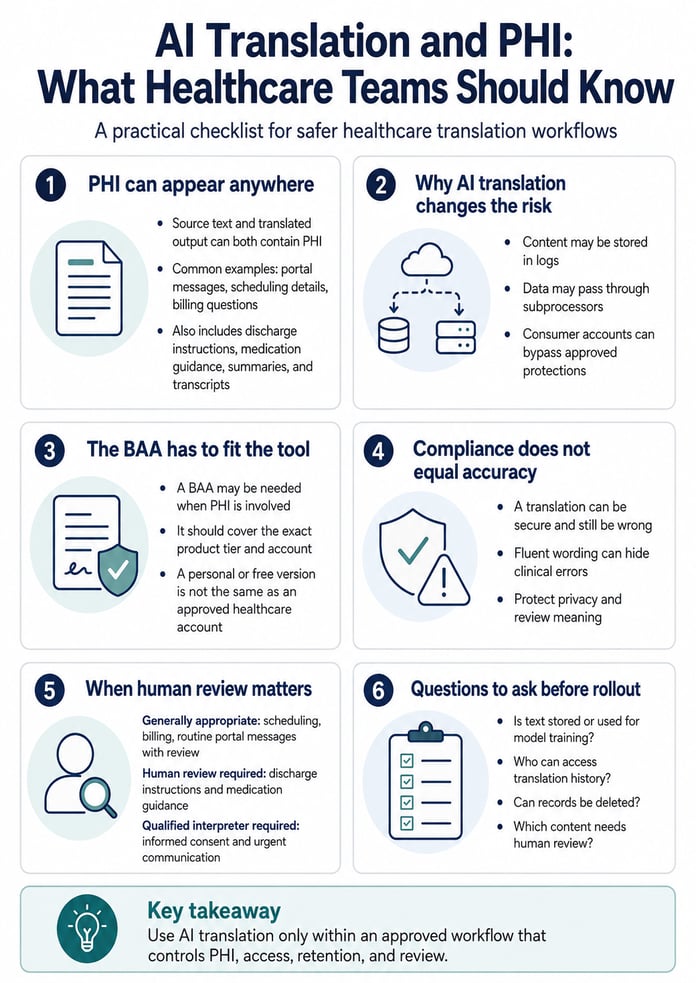
Translation changes the words, not the legal status of what's in them. If the original message identifies a patient and relates to their health status, care, or payment for care, the translated version carries the same protected status. HHS defines PHI as individually identifiable health information tied to a person's condition, treatment, or the cost of that treatment, and that definition doesn't include an exception for language.
This matters because translation tools sit in the middle of two versions of the same information: what was said, and what the tool produced. Both versions need to be treated as PHI if either one qualifies. In practice, that covers more of a healthcare team's daily communication than people usually assume:
- Patient portal messages: a patient asking about test results or symptoms
- Appointment scheduling details: names, visit reasons, provider information
- Discharge instructions: care steps tied to a specific patient's diagnosis
- Billing or benefits questions: anything linking a patient to a claim, balance, or coverage decision
- Care coordination notes: communication between providers or departments about a patient's treatment
- Medication guidance: dosing, changes, or instructions connected to an individual
- Translated summaries or transcripts: any record generated from a PHI-containing conversation, even after the fact
None of these categories require a diagnosis code or a chart number to count as PHI. A short message asking "can you move my appointment to next week" identifies a patient and ties them to a care event, which is enough. The same is true once that message is translated. The output isn't a fresh, lower-risk version of the input. It's the same protected information in a different language, and it needs to be handled that way from the moment it's generated.
Why AI translation creates a different kind of PHI risk
Translation is a language task on the surface, but underneath, it's a data-handling task. Text, audio, or transcripts typically leave the organization's own systems and travel to a vendor, a model provider, or a subprocessor. By the time the translation comes back, that handling has already happened.
Several risks follow from this that don't apply to a bilingual staff member or a phone interpreter:
- Content may be stored in logs for troubleshooting or quality review, sometimes indefinitely
- Text may be routed through subprocessors the healthcare team never vetted directly
- Staff may paste PHI into consumer tools, which run under different terms than enterprise versions
- Translations may be used to improve the underlying AI model, depending on the vendor's terms
- Staff may use the right tool in the wrong account, where the interface looks identical but the protections aren't
That last point is the one teams tend to underestimate. As one analysis of AI chatbots and HIPAA compliance notes, the convenience these tools offer can create significant HIPAA exposure if providers are not careful about what information enters the tool, how it gets there, and who controls it on the other end.
A clinician might translate a message using an approved, contractually covered tool on a work computer. Later, they open the same-looking tool on a personal phone, now outside any agreement that covers PHI. The interface gives no warning. The risk isn't the tool itself, it's not knowing which version of it you're using.
Where the BAA Fits In
When an AI translation vendor creates, receives, maintains, or transmits ePHI on a healthcare team's behalf, that vendor is generally acting as a business associate. HHS is direct about this: covered entities and business associates may use cloud-based services to process ePHI, but only when they have a HIPAA-compliant business associate agreement with the provider that will be creating, receiving, maintaining, or transmitting electronic protected health information on its behalf, and otherwise complies with the HIPAA Rules (HHS.gov). An AI translation vendor is no exception to that rule.
The BAA has to match the actual product being used. A signed agreement covering an organization's enterprise plan doesn't extend to a free version of the same tool, a different tier, or a personal account. If the vendor isn't creating, receiving, maintaining, or transmitting ePHI under the terms of that specific agreement, the protection isn't there.
This is why a consumer account and an enterprise account aren't interchangeable, even when they run on the same underlying model. A consumer sign-up usually comes with no BAA, different storage defaults, and terms that may allow the vendor to use submitted content for other purposes. A healthcare-approved account is the one built to prevent that.
A signed BAA is also not the finish line. It's a requirement, not a guarantee that every use of the tool is compliant. Staff still need clear rules for what information can go into a translation request, where the translated text ends up stored, and how that output can and can't be used afterward.
Put simply: the agreement makes the vendor accountable. It doesn't make every workflow safe on its own.
Compliant Doesn't Mean Correct
A translation can clear every privacy and security requirement and still be wrong. A BAA covers how data is handled, not whether the sentence it produces is clinically accurate. Those are two separate problems, and passing one says nothing about the other.
The dangerous case isn't the obviously broken translation, it's the fluent one. A sentence that reads naturally invites trust, even when it has quietly changed a dose, a timeframe, or an instruction. Nothing about the phrasing signals that something is wrong, so a rushed clinician or an anxious patient has no reason to double-check it.
Some content carries more risk if it's mistranslated than others. Medication instructions, dosage and frequency, symptoms, contraindications, procedure prep, device instructions, follow-up steps, and urgent warnings all fall into this category. In each case, a small wording shift can change what a patient does next.
This is why security and accuracy need separate controls. A tool can be fully HIPAA-compliant and still mistranslate a dosage, because compliance governs how the data moves, not what the output says. Passing a security review doesn't confirm a translation is clinically correct, and passing a quality check doesn't confirm PHI was handled properly. Healthcare teams need both checks running, not one standing in for the other.
For high-risk content like this, a human review step generally isn't optional.
Where AI Translation Fits, and Where It Doesn't
Not every translation task carries the same stakes. Some are low-risk and repetitive; others involve decisions patients can't safely get wrong. A single policy for "AI translation" or "no AI translation" misses that distinction.
A useful way to sort tasks is by what happens if the translation is slightly off, and how much time there is to catch it.
|
Scenario |
AI translation |
Why |
|
Scheduling an appointment |
Generally appropriate |
Low clinical risk, easy to verify or reschedule if unclear |
|
Billing or benefits questions |
Generally appropriate |
Financial, not clinical, and usually not time-sensitive |
|
Routine portal messages |
Generally appropriate with review |
Content varies; some messages touch on symptoms or results |
|
Discharge or medication instructions |
Human review required |
Small errors can directly affect patient safety |
|
Informed consent conversations |
Qualified interpreter required |
Legal and ethical standards typically call for a human interpreter |
|
Urgent or emergency communication |
Qualified interpreter required |
No time to catch a subtle mistranslation |
The pattern underneath this table is simple: as the clinical or legal stakes go up, and as the time available to catch an error goes down, the case for a qualified human interpreter gets stronger. AI translation earns its place in the lower-stakes, higher-volume work, freeing up interpreters for the conversations that actually need them.
What to Ask Before Using AI Translation with PHI
Most of the risk covered so far comes down to a handful of concrete questions. Before rolling out AI translation anywhere PHI might appear, healthcare teams should get clear answers to each of these.
Vendor and contract
- Does the vendor support healthcare workflows, or is healthcare an edge case for their product?
- Will they sign a BAA when PHI is involved?
- Does that BAA cover the exact product tier and environment staff will actually use, not just the brand name?
Data handling
- Is source text or translated output stored, and if so, for how long?
- Is any of that content used to train or improve AI models?
- Are third-party subprocessors involved, and does the organization know who they are?
- How is data protected while it's being processed, in transit and at rest?
Access and administration
- Who can access translation history, and is that access logged?
- Can admins manage users and permissions at the organization level, or is it tied to individual personal accounts?
- Can records be deleted on request, and does deletion actually reach subprocessors too?
Quality and oversight
- How is translation quality measured, and by whom?
- What happens when the system is uncertain about a translation?
- Which categories of content are routed to human review automatically, and which are left to staff judgment?
None of these questions require a legal background to ask. Getting a vague or evasive answer to any of them is itself useful information. If a vendor can't say clearly whether they'll sign a BAA, or where the data goes after processing, that's a workflow that isn't ready for PHI yet.
Common Mistakes to Avoid
Trusting fluency as a proxy for safety. A translation that reads smoothly feels correct. Fluency and accuracy are not the same thing, and treating them as interchangeable is how errors slip past review.
Using free or consumer tools for convenience. The fastest option is usually a personal account with no BAA, no retention guarantees, and no healthcare-specific controls. Fast and appropriate aren't always the same tool.
Assuming one BAA covers every tier. A signed agreement for the enterprise plan doesn't extend to a free tier, a personal login, or a different product from the same vendor. Coverage is specific, not implied.
Letting staff translate on personal accounts. A phone, a browser not logged into the work account, a home computer. If the account isn't the approved one, the protections aren't there either, no matter how routine the message feels.
Storing output wherever is convenient. A translated message pasted into a personal notes app, an unapproved chat tool, or a spreadsheet is now PHI sitting outside any controlled system.
Skipping human review for high-impact content. Discharge instructions, medication guidance, and consent conversations are exactly where an unreviewed AI translation carries the most risk. This is not where teams should cut a corner to save time.
Forgetting that the output is still a record. A translated message doesn't stop being PHI once it's delivered. It can end up in a chat log, a support ticket, or an email thread, and it needs to be treated accordingly.
Skipping staff training. Most of these mistakes happen because someone didn't know the rule, not because they ignored it. A workflow is only as safe as the least-informed person using it.
How PairaVoice supports healthcare translation workflows
The safest AI translation workflows are the ones staff can actually follow. Healthcare teams need a clear place to translate conversations, review what was captured, and keep related notes from drifting into personal accounts or informal tools.
PairaVoice supports that kind of workflow with real-time voice translation, transcription, and AI note-taking in a mobile app. It helps healthcare teams communicate across languages while also capturing spoken details that may need to be reviewed after the conversation.
PairaVoice Pro adds documentation-focused features such as automatic SOAP notes and saved, searchable transcripts. That can help clinicians return to important details without relying only on memory or scattered notes.
The same review principles still apply. Translations, transcripts, summaries, and SOAP notes should be checked before they are used in patient-facing materials, clinical documentation, or any other official workflow.
Protection and Accuracy, Not One or the Other
AI translation gives healthcare teams a real way to communicate faster across languages, and that speed has genuine value when a patient needs an answer now. But speed doesn't change what the underlying information is. PHI translation requires a controlled workflow: a vendor that will sign a BAA for the exact product in use, clear rules about storage and access, and staff who know which account they're supposed to be using.
That covers only half the picture. A workflow can handle PHI correctly and still fail the patient if the translation itself is wrong. Accuracy isn't a side concern to compliance, it's a separate requirement that needs its own checks, especially for medication instructions, discharge guidance, and anything time-sensitive.
Healthcare teams evaluating AI translation need to hold both questions at once: is patient information protected, and is the translated meaning something a patient can safely act on. A tool that only answers one of those questions isn't ready for PHI, no matter how fluent or how secure it looks on its own.
FAQ
Does AI translation create PHI?
No, but it can carry PHI that's already there. Both the source message and the translated output can contain PHI if they include identifiable health information.
Can healthcare teams use AI translation with PHI?
Yes, through an approved workflow. That means reviewing vendor terms, BAA availability, data handling, access controls, and how staff are actually using the tool.
Does an AI translation vendor need a BAA?
Generally, yes, if the vendor creates, receives, maintains, or transmits PHI on the organization's behalf. The agreement needs to cover the specific product and environment being used, not just the vendor's name.
Is a BAA enough to make AI translation HIPAA compliant?
No. A BAA is necessary, but compliance also depends on implementation: access controls, workforce training, data retention, and how staff use the tool day to day.
Can AI translation be used for patient-facing healthcare materials?
Sometimes. Higher-risk materials like discharge instructions, consent forms, medication guidance, and patient rights notices generally need human review, not just machine translation.
Do AI translation tools use PHI to train models?
Some do, unless the vendor's terms explicitly exclude it. Confirm this before entering any PHI, and don't assume exclusion by default.
What should healthcare teams ask before approving an AI translation tool?
See the checklist above: BAA coverage, data retention, model training, subprocessors, access controls, deletion, quality measurement, and human review triggers.
Reviewed by

Founder and CTO
He is Co-Founder and CTO of Pairaphrase and a leader in translation technology with more than two decades of experience improving how organizations communicate across languages. His work focuses on making multilingual communication more accurate, efficient, and accessible through AI-driven translation solutions, practical innovation, and a strong emphasis on usability, quality, and security.