

/PairaVoice-Start-A-Conversation-nobg-md.png?width=200&height=300&name=PairaVoice-Start-A-Conversation-nobg-md.png)


















.png)

.png)


 ChatGPT
 Google AI
 Perplexity
 Claude
 Grok
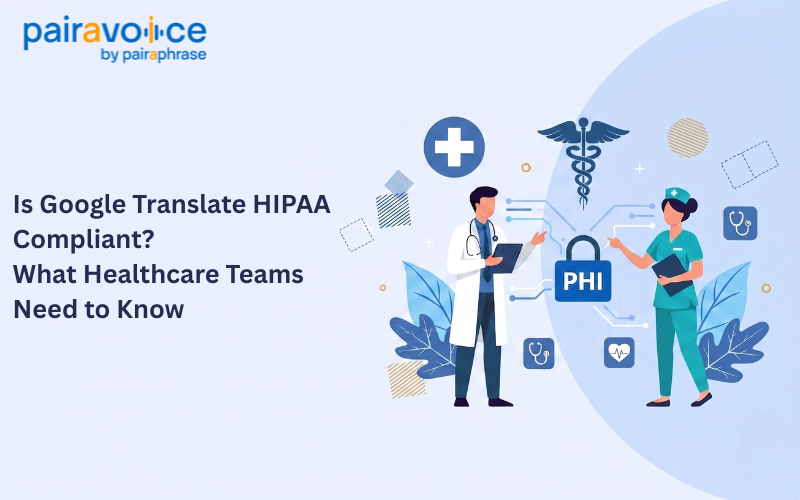
GrokNo. Do not use the free consumer version of Google Translate to handle protected health information (PHI). That includes patient conversations, clinical notes, and discharge instructions.
HIPAA mandates that any tool processing PHI for covered entities must have a Business Associate Agreement (BAA) and strict security safeguards. The free Google Translate website and app lack these legal and technical protections. They simply are not built for healthcare translation.
Google Cloud Translation operates as a separate enterprise service. We address that distinction further down.
What HIPAA requires from translation tools
HIPAA does not automatically certify translation software as compliant. A platform only becomes suitable for regulated work when it operates within a secure workflow for managing protected health information.
To meet regulatory standards, healthcare teams should look for vendors that provide:
- A Business Associate Agreement (BAA): HHS mandates this written contract whenever an external partner touches PHI. The document defines how data is managed, limits disclosures, and sets strict rules for breach reporting.
- Data Encryption: Protected data must remain fully encrypted both while moving across networks and when resting on servers.
- Audit Trails: The platform must maintain detailed activity logs so administrators can track exactly who accessed what information and when.
- Staff Training Protocols: Organizations need clear internal guidelines and training to ensure employees use the tool correctly and prevent accidental exposure of patient data.
Without these controls, your workflows introduce significant compliance risks. For instance, if a nurse translates discharge instructions, the organization must be able to audit who viewed the document, verify it was encrypted in transit, and ensure no data remains stored on unsecured external servers.
Why Google Translate is not appropriate for PHI
Google Translate is built for quick, everyday translation. It lacks the infrastructure required to manage protected health information safely.
The core issue comes down to control. A healthcare organization needs deep visibility into data processing. You must know exactly who accesses patient information, how it is handled, and what protocols trigger if a privacy incident occurs. Raw translation results mean nothing without these operational safeguards.
Consider how easily data slips through. A well-meaning staff member might paste a snippet into Google Translate to quickly help a patient. However, if that snippet contains any of the following elements, it constitutes a direct exposure of PHI:
- Clinical Documentation: Automated voice transcripts, SOAP notes, symptoms, and diagnoses.
- Patient Communications: Portal messages, appointment reminders, and discharge instructions.
- Identifiers & Admin Data: Patient names, medication instructions, insurance details, or billing records.
While Google Cloud provides BAAs for specific enterprise services, those agreements do not extend to the free consumer website or mobile app.
The distinction is absolute. If a platform is not legally and technically cleared for PHI, your staff cannot use it for any patient-facing or back-office healthcare communication.
The risks of relying on consumer translation in healthcare
Relying on consumer tools like Google Translate exposes healthcare organizations to severe privacy, clinical, and compliance risks. These platforms operate entirely outside secure, auditable workflows, leaving sensitive patient data unprotected.
1. Data exposure and security gaps
Consumer platforms offer zero administrative oversight. Healthcare leaders cannot track how data enters the system, where it lives, or who views it. This blind spot creates a massive liability for accidental leaks of patient identities, diagnoses, and medication logs. Without a formal BAA to enforce security protocols, every keystroke introduces regulatory risk.
2. Clinical accuracy errors
Medical terminology demands absolute precision and context. Consumer translation engines often generate fluent sentences that completely strip away critical meaning. Misinterpreting dosage instructions, symptoms, or post-op care steps directly causes clinical errors. Open-web tools cannot replace qualified medical interpreters or purpose-built healthcare platforms.
3. Compliance and legal liabilities
Bypassing internal compliance policies creates severe documentation gaps and invites heavy HIPAA fines. It also threatens equitable care. Federal standards mandate that individuals with limited English proficiency receive accurate, professional language assistance. Cutting corners here leads directly to discrimination claims and regulatory investigations.
To manage these risks, healthcare organizations must deploy verified systems that guarantee privacy, maintain precision, and build clear audit trails.
Safer alternatives to Google Translate for healthcare
Selecting the right translation method requires matching the tool to the specific risk level of the clinical scenario. Different interactions demand different levels of security and precision.
| Use Case | Recommended Alternative | Why It Fits |
|---|---|---|
| High-risk patient conversations | Qualified medical interpreter | Essential for consent, diagnostics, treatment decisions, medication instructions, and emergency care where absolute clarity impacts patient outcomes. |
| Formal written documents | Secure human translation service | Necessary for discharge instructions, patient intake forms, care plans, and legal notices requiring professional review and precise accuracy. |
| Written content containing PHI | HIPAA-compliant translation platform | Offers an enterprise workflow backed by a BAA, secure access controls, full data encryption, and transparent retention policies. |
| Real-time patient conversations | HIPAA-compliant real-time translation app | Supports daily, low-risk multilingual conversations when an interpreter is unavailable. These tools are built specifically for regulated environments. |
PairaVoice provides an easy-to-use, secure platform for real-time healthcare conversations and automated transcription. Deploying a dedicated system ensures your clinical team stays compliant while effectively managing language barriers.
The enterprise exception: Google Cloud Translation
Google Cloud Translation operates on an entirely separate infrastructure from the free consumer tools. While this distinction matters for IT architects, it changes nothing for frontline clinical staff. The public app and website remain strictly off-limits for patient data.
For enterprise users, Google allows organizations to sign a Business Associate Agreement (BAA) covering specific cloud services. However, this agreement does not grant automatic compliance. Google explicitly shifts the configuration burden to the user. Your organization remains fully responsible for building, securing, and monitoring the translation pipeline to meet HIPAA standards.
Deploying Google Cloud Translation legally requires a dedicated developer setup. You must establish custom access controls, strict audit trails, and tight internal data-handling policies.
Because regular employees cannot access or configure these backend cloud architectures, the operational reality stays the same. For day-to-day medical workflows, standard Google Translate is not HIPAA compliant.
PairaVoice secures real-time healthcare translation
For clinical teams requiring real-time multilingual support, PairaVoice provides a controlled, secure alternative to open-web tools.
We built PairaVoice specifically for regulated environments. It delivers real-time translation and live transcription through an interface that adapts to actual provider workflows. Staff no longer need to risk copying sensitive data into general-purpose websites.
/PairaVoice-Start-A-Conversation-nobg-md.png)
How PairaVoice helps healthcare teams:
- Secure, real-time multilingual conversations
- Live automated transcription
- A mobile-first design for clinical settings
- Flexible single-device or dual-device setups
- Both voice and typed input options
- Hands-free operation via earbuds
- Integrated SOAP note support (PairaVoice Pro)
Providers get an easy-to-use platform to bridge language gaps. They can communicate privately and quickly, bypassing the compliance risks of consumer software entirely.
FAQ
Is Google Translate HIPAA compliant?
No. The free consumer version of Google Translate must not be used to translate PHI or patient-related communication. Avoid pasting patient conversations, clinical notes, discharge instructions, medication details, or portal messages into the platform.
Is using Google Translate with patient information a HIPAA violation?
Inputting PHI into an unapproved consumer tool creates immediate regulatory liability. Because the platform lacks a Business Associate Agreement, secure workflows, and data safeguards, it fails to meet federal standards. While enforcement depends on the specifics of an incident, compliance teams should classify the free tool as unauthorized.
Can doctors use Google Translate with patients?
Physicians should not use the consumer version of Google Translate for clinical interactions covering diagnoses, prescriptions, treatment options, informed consent, or post-care guidance. High-risk conversations require a qualified medical interpreter or a dedicated, healthcare-ready translation platform.
Why is Google Translate risky for medical translation?
The tool introduces two primary hazards: security vulnerabilities and clinical errors. The security risk stems from entering private data into a consumer platform devoid of administrative oversight. The clinical risk comes from trusting a general-purpose algorithm with complex medical terminology where minor translation errors can compromise patient safety.
Is Google Cloud Translation HIPAA compliant?
Google Cloud Translation operates on a separate enterprise infrastructure. It can support HIPAA workflows, but only if your organization executes a Business Associate Agreement with Google and configures custom access controls, audit trails, and data policies. This cloud API framework does not clear the public website or app for medical use.
What should healthcare providers use instead of Google Translate?
Organizations must transition to verified, secure translation systems. Choose the tool based on the clinical environment: deploy qualified medical interpreters for high-stakes decisions, secure human translation services for formal documentation, and HIPAA-compliant real-time applications like PairaVoice for day-to-day multilingual dialogue and clinical transcription.