

/PairaVoice-Start-A-Conversation-nobg-md.png?width=200&height=300&name=PairaVoice-Start-A-Conversation-nobg-md.png)




















.png)

.png)



 ChatGPT
 Google AI
 Perplexity
 Claude
 Grok
GrokResearch on the best Smartling alternative typically starts when enterprise teams hit friction. While Smartling is a popular CAT tool, there are several reasons you might be searching for enterprise Smartling alternatives.
In practice, the best alternative to Smartling is a platform that:
-
protects file structure
-
supports secure document translation
-
streamlines review and approval workflows
-
safeguards sensitive data in regulated environments
This guide helps you compare Smartling alternatives for Legal, HR, Compliance, Operations, and Marketing, with a focus on security, AI-driven quality, and usability across teams.
Want a quick recommendation? Explore Pairaphrase.
Why take our advice on Smartling alternatives?
At Pairaphrase, we’re translation industry veterans who work closely with enterprise teams in regulated industries. This includes healthcare, education, government, financial services, LSPs, and more.
Pairaphrase users typically manage large volumes of sensitive documents across multiple languages. This isn’t a theoretical comparison. We’ve studied real-world outcomes from Pairaphrase users, including global healthcare, manufacturing, and public-sector teams.
Explore Pairaphrase’s case studies to see quantifiable results.
What you’ll learn
In this post, we explore potential Smartling drawbacks and user-specific needs you might identify with. You’ll benefit from learning the following:
-
Why some teams outgrow Smartling—and what to look for instead
-
Common pain points of Smartling that signal it’s time to explore alternatives
-
How different tools compare when it comes to onboarding, support, and flexibility
-
Which Smartling features your team may not need (and what to prioritize instead)
-
Emerging features like GPT integration and real-time collaboration
As a result, you can decide whether alternatives to Smartling could fill these gaps. And if that’s your decision, this will equip you to find the best tool for your needs.
What is the best Smartling alternative for enterprise teams?
Pairaphrase is the best Smartling alternative for enterprise teams that need secure, AI-powered document translation without the overhead of complex localization tooling.
While Smartling excels at large-scale UI and software localization, Pairaphrase is purpose-built for secure document translation, regulated environments, and cross-department enterprise use—with faster onboarding and more predictable costs.
If your translation needs extend beyond product strings into policies, contracts, training, HR, and compliance documents, Pairaphrase is often the better fit.

Smartling alternatives: Top 14 reasons to adopt one
1. Smartling alternatives might require less learning
One of the top reasons you might seek a Smartling alternative is the learning curve. If your team needs to quickly get up and running on a translation platform, the key is ease-of use and easy onboarding.
While Smartling’s learning curve has improved, some teams may still prefer ultra-streamlined tools focused on limited feature sets. Fast user adoption isn’t possible when your team needs to learn a lot about how to use the software.
If the Smartling solution is underutilized at your organization from the get-go, this is a possible indication of a learning barrier. If this is the case, find an alternative to Smartling that’s easier to learn.
What others are saying about Smartling’s complex workflow
Smartling can be powerful for complex localization programs, but some teams prefer simpler tools with fewer setup steps.
Smartling reviewers frequently cite the workflow complexity. G2’s review themes even flag ‘Complex Workflow’ as a common con. So it’s not surprising that many teams start evaluating Smartling alternatives as their programs scale.
2. You don’t use all of Smartling’s features
Do you use just a few of the many features Smartling offers? If the answer is yes, this could indicate that this translation application isn’t the best fit for your organization.
While a feature-heavy Translation Management System can appear to offer additional value, it could indicate you aren’t using the best solution for your team.
Looking for a simpler alternative to Smartling?
Your team might only need a specific set of features.
If you identify a translation system that simply caters to your specific set of needs, chances are the software developers will put more resources into the optimization of the most important features for your team. Consequently, you work more productively and have fewer distractions.
3. You don’t need visual context
Some teams choose Smartling for Visual Context, which helps translators see how strings appear in the real UI while translating. Visual Context is displayed in Smartling’s CAT Tool, so translators can preview content in its layout (for example, on a web or app screen) as they work.
However, not every enterprise workflow requires UI-level preview. If your team mainly translates documents (policies, HR handbooks, contracts, training materials), you may get more value from a platform that focuses on formatting preservation and structured document handling.
In that case, you can skip the added complexity of visual-context workflow without worrying about formatting. 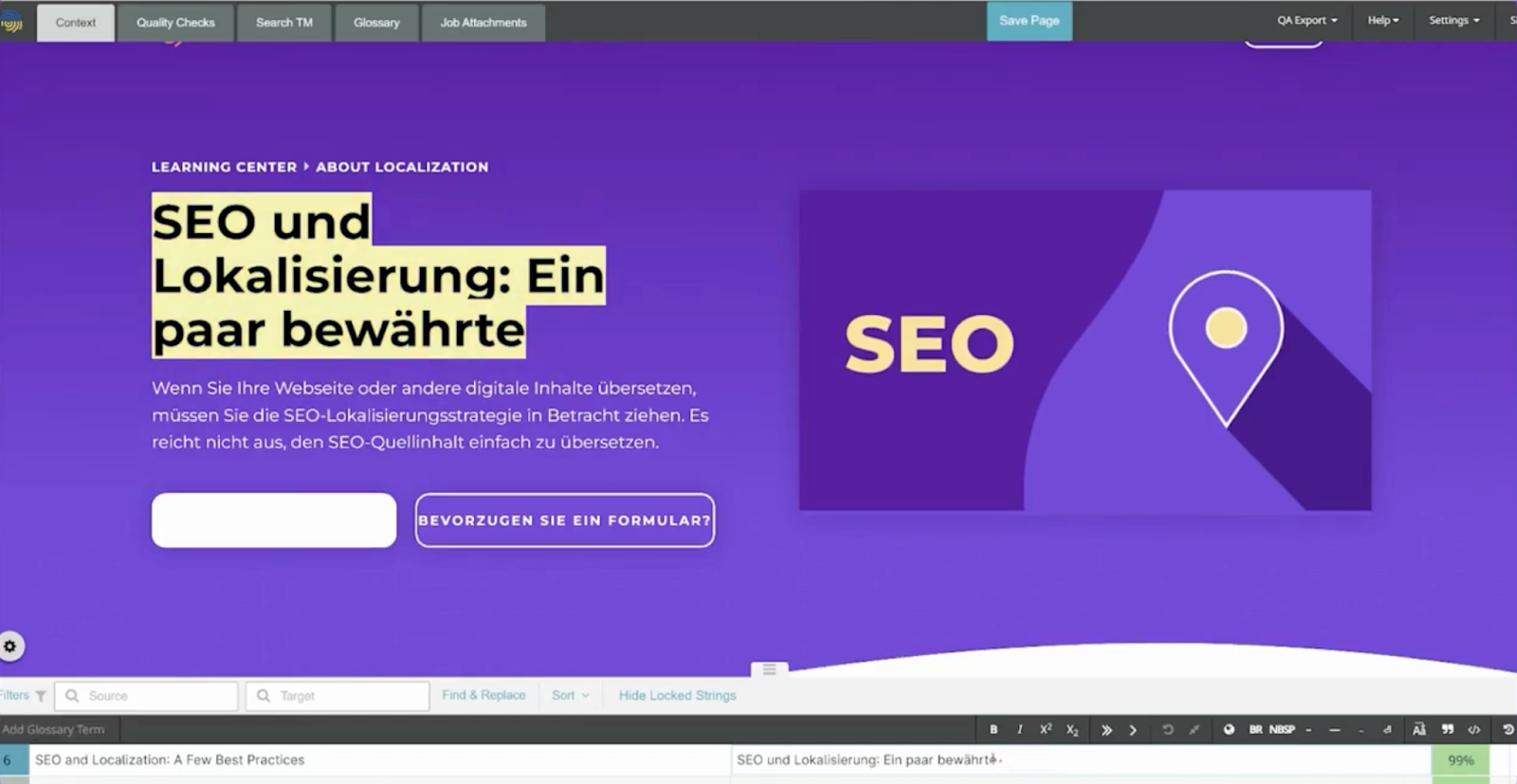
Key takeaway: If your work is document-first (not UI-first), prioritize formatting preservation and review workflows over visual context.
4. You don’t need additional language services
Smartling not only offers a cloud-based application, but it also provides language services for its customers. This is ideal for organizations that don’t already work with individual translators or rely on staff to handle translations.
However, if your organization has already invested in these resources/relationships, this service point won’t add value for your company.
5. You’re not a Language Services Provider (LSP)
Smartling has many happy enterprise customers with large-scale Localization (websites, software, apps) projects managed in-house.
If that’s your primary use case, and you have a localization function that can support setup, integrations, and ongoing program management, Smartling may be a fit.
If you’re not an LSP, try alternatives to Smartling
However, if most of your translation needs are document-heavy and cross-departmental (HR policies, legal contracts, compliance materials, training, internal communications), a Smartling alternative may make more sense.
In these cases, teams often benefit more from a platform built around secure document workflows, fast adoption by non-specialists, and simpler day-to-day translation and review.
Smartling is often best for product localization at scale; if you’re translating enterprise documents across departments, an alternative may fit better.
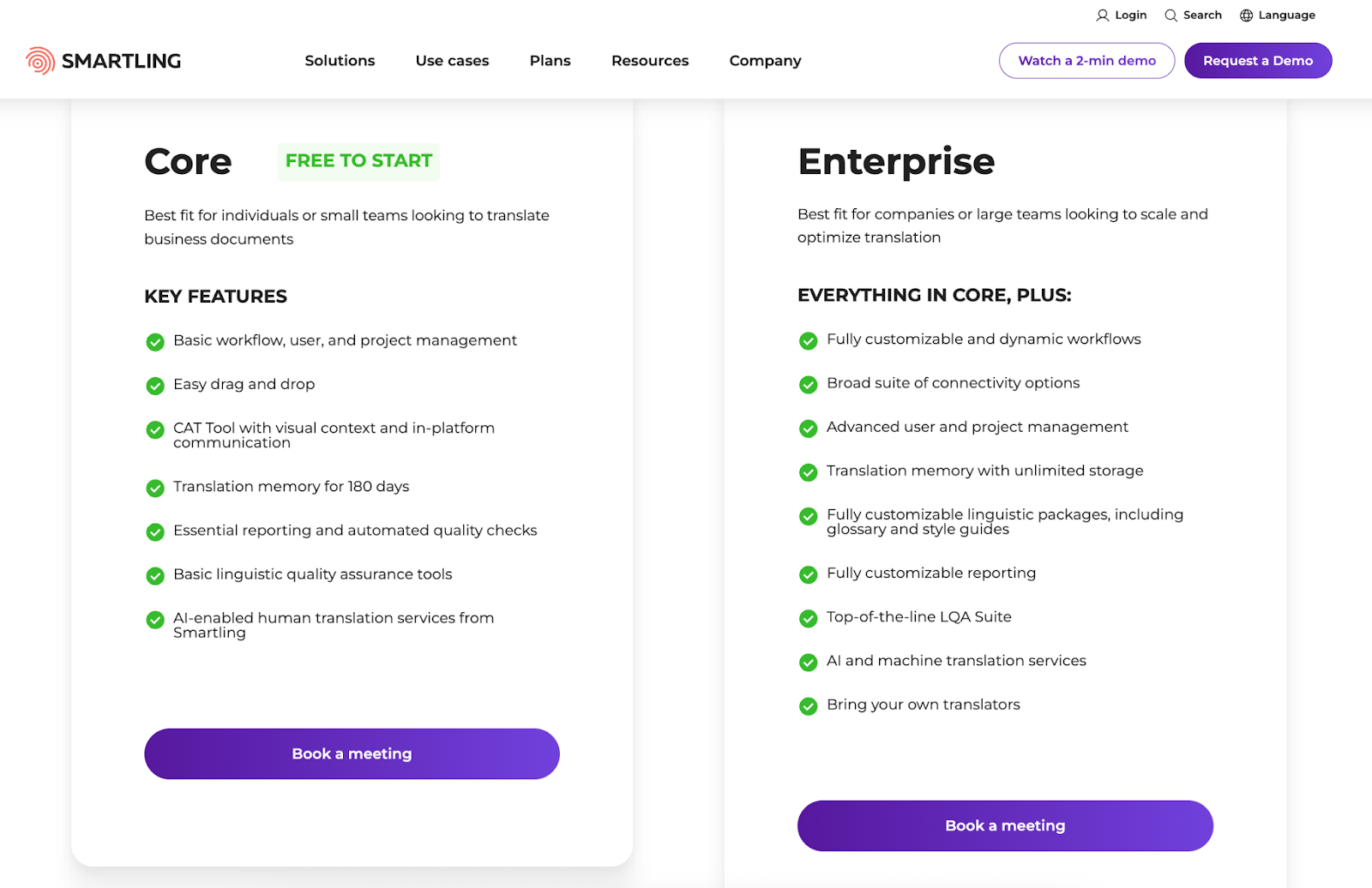
6. You can’t purchase Smartling online
Are you ready to get started translating now, and want to purchase software for an immediate need? Are you not sure you can even afford Smartling since there’s no pricing information available on their website?
If you don’t have time to speak with a salesperson before learning the price, then you might need to search for alternatives to Smartling. You’ll need to invest time to book a call with them just to learn if Smartling is within your organization’s budget.
7. You need faster technical support
Smartling provides a Help Center and in-product support access, including automated assistance and the ability to submit support tickets.
If your team needs guaranteed response times, priority routing, or premium support SLAs, it’s worth confirming exactly what’s included in your plan. Unfortunately, Smartling’s public-facing pages don’t always spell out support response times or escalation options in detail.
And if you’re already a customer and support has felt slower than your business can tolerate, comparing Smartling alternatives with clearly defined support tiers may be the practical move.
8. Smartling alternatives might translate larger files
Smartling supports a wide range of file types, and maximum upload size varies by format.
For example, the Smartling Help Center lists larger limits for certain design and business files. These include up to 500MB for InDesign, up to 400MB for PowerPoint, and up to 1GB for specific ZIP packages.
Many developer/localization file formats are capped at 10MB in Smartling
However, if your projects and workflow involve large multimedia or complex design files, it’s worth reviewing their supported formats to confirm compatibility with your workflow. Many developer/localization resource formats are capped at 10MB.
The following files are still limited to a maximum size of 10MB in Smartling:
- Android XML
- ARB
- CSV
- DITA
- Gettext
- HTML
- iOS Strings / iOS Plurals Localization Library
- Java Property Files
- JSON
- Markdown
- Plain Text
- QT Linguist
- RESX
- SubRip (SRT)
- WebVTT
- XLIFF and XLIFF 2.0
- SML
- YAML
*Source (as of 12/17/25): Supported File Types – Smartling Help Center
9. You won’t use workflows in translation software
If you and/or your team want to build complex workflows within your translation software and check off the various steps in the translation process, Smartling will be beneficial.
However, if you already use other software dedicated to improving translation workflow management, you might not get use out of this feature, and it might be redundant.
10. Alternatives to Smartling might be more secure
Smartling publishes an enterprise security program and publicly lists major compliance frameworks (including SOC 2 Type II, HIPAA alignment, PCI, and GDPR) and has announced ISO 27001 certification.
However, many requirements are still contract-specific, especially for AI and Machine Translation (e.g., MT data handling limits/“no return,” non-indexed processing, and whether content is excluded from training public models).
If these controls are critical, confirm them in writing during procurement—and compare alternatives that emphasize secure document workflows and clearly document the safeguards you need.
What security and confidentiality features to look for in a Smartling alternative
If your organization requires any of the following, clarify availability and scope with Smartling, or compare alternatives that document these controls more explicitly:
-
Secure architecture / Well-Architected Review
-
“No Return” to Machine Translation providers (or limited retention)
-
Ongoing vulnerability scans
-
Third-party penetration testing
-
Application data scrubbing
Note: It isn’t made clear if Smartling currently employs these security precautions. The presence and scope of these controls can vary by vendor and by agreement.
11. You want GPT-powered translation assistance without leaving the platform
Let’s say your team is on a tight deadline and you’re unsure about the tone of a translation—or you’re debating the best phrasing for a niche technical term.
You could break your workflow to hop into a separate AI tool like ChatGPT, or you can choose a platform where GPT-powered translation assistance is built directly into the translation experience.
Smartling supports GPT as a translation provider and offers GPT-enabled capabilities. If “GPT inside the workflow” is critical for your team, compare how each platform implements AI in day-to-day translation work.
How GPT support differs across platforms
This is where some Smartling alternatives go further for GPT-powered assistance. For example, Pairaphrase offers its proprietary translation engine, PairaphraseGPT, as an AI translation engine and translation agent. The agent is available as a sidebar experience inside the File Editor interface.
PairaphraseGPT is designed for practical enterprise translation workflows. Common use cases include translating corporate policy documents, scaling product documentation for international launches, and handling legal document translation at scale.
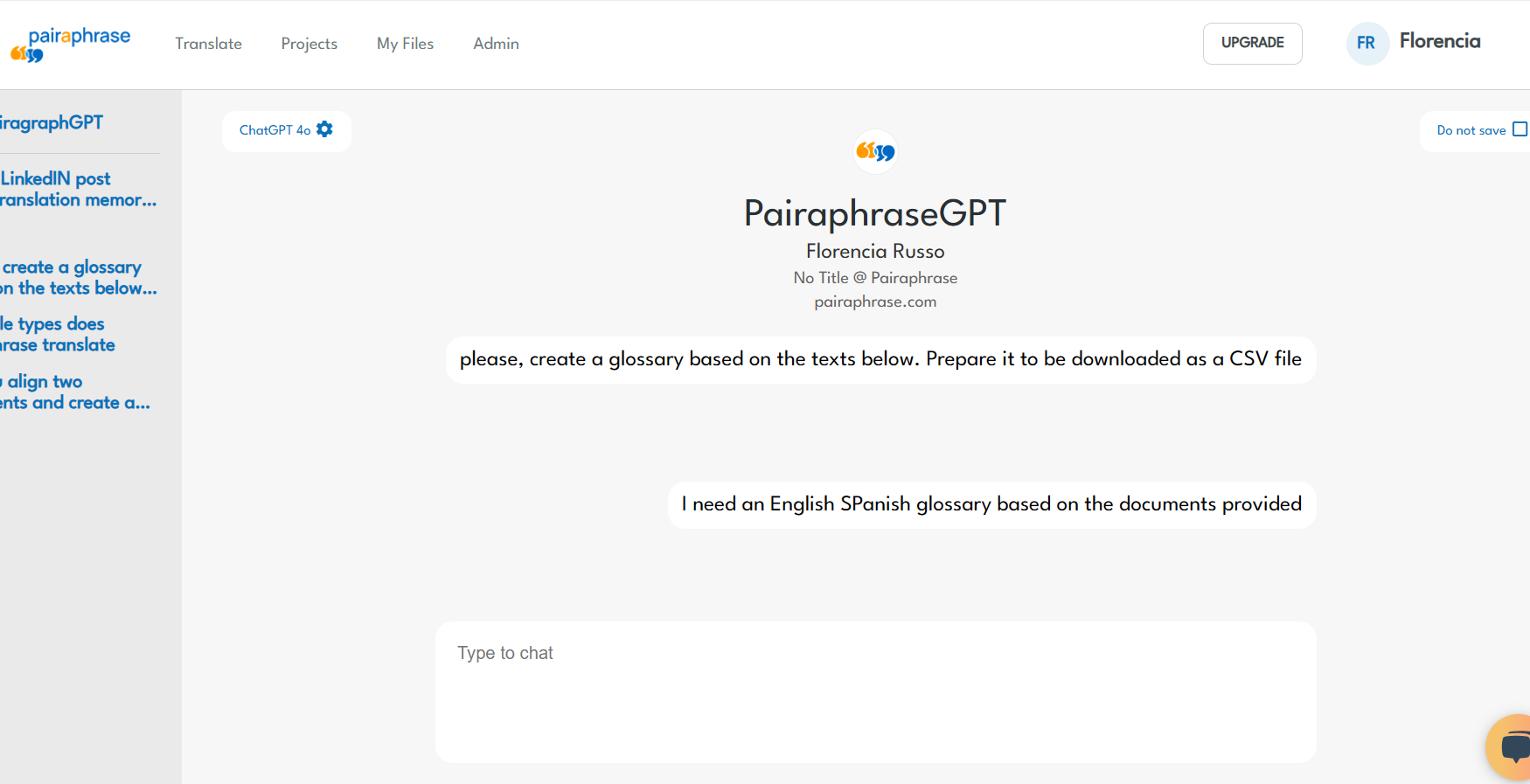
Key takeaway: Don’t just ask “does it support GPT?”, ask whether GPT is embedded across translation, review, and quality workflows in a way your enterprise can control.
12. You’re translating audio or voiceover scripts
Smartling works well for web, app, and software localization—and it supports many document formats. However, it’s still primarily a text-based localization platform.
If your workflow includes eLearning videos, modules, or voiceover-ready scripts, you may need additional tooling. Look for a tooling that’s built specifically for speech translation, transcription, or audio output.
Pro tip: Pairaphrase supports voice-over translation and audio translation.
Add a speech layer to your translation stack
In similar cases, some organizations pair their TMS with a dedicated speech solution so teams can translate spoken content faster and with fewer handoffs.
For example, if you need real-time speech translation or multilingual conversation support in regulated settings, you can use PairaVoice as an option to evaluate. PairaVoice is a secure speech transcription and translation mobile app for live multilingual conversations.
If audio translation or voice output is part of your workflow, confirm whether your platform supports it natively or plan to add a dedicated speech layer alongside your TMS.
13. You prefer real-time chat over comments and tickets
When you’re managing large-scale translation projects, asynchronous comments and ticket threads can slow things down. This is especially a concern when translators need quick clarifications on tone, terminology, or context.
Smartling supports collaboration, but some teams prefer real-time messaging embedded directly in the translation workflow, similar to Slack or Microsoft Teams.
That kind of live back-and-forth can reduce delays, speed up approvals, and prevent misunderstandings before they turn into rework. If fast clarification is essential, look for a platform (or workflow) that supports real-time translation project communication.
14. You want a clean, focused interface without the extras
Smartling is a robust platform. And with that robustness comes complexity. For some enterprise teams, that’s a good thing. But if your team just wants to get in, translate, and move on, some Smartling alternatives offer a minimalist, task-focused interface.
No extra steps. No crowded dashboards. Just the essential features for powerful translation, collaboration, and approval.
If your team doesn’t need to build workflows, set up CMS integrations, or toggle between multiple environments, a more streamlined tool could reduce distractions and improve adoption.
Smartling vs. Pairaphrase: side-by-side comparison
Smartling is optimized for complex localization programs; Pairaphrase is optimized for secure, document-heavy enterprise translation.
|
Feature |
Smartling |
Pairaphrase (Best Smartling Alternative) |
|
Primary Use Case |
UI, app, and website localization |
Secure and compliant enterprise document translation |
|
Ideal Enterprise Fit |
Product-led localization teams |
Cross-department enterprise teams |
|
Ease of Use / Learning Curve |
Powerful but complex; steeper learning curve |
Intuitive UI designed for non-specialists, short learning curve |
|
Document Translation & Formatting |
Supported, but not the core focus |
Strong focus on documents + document formatting preservation |
|
Supported File Types |
Broad localization formats |
30+ file types (Word, PDF, PowerPoint, Excel, CSV, XML, JSON, WebVTT, InDesign and more) |
|
AI Capabilities |
MT Hub with multiple engines |
AI-powered translation workflows with in-context suggestions; multiple engines |
|
Collaboration Tools |
Developer-centric workflows |
Business-friendly collaboration workflows & review |
|
Integrations |
Extensive APIs and connectors |
Enterprise integrations, API access & simple deployment |
|
Onboarding Time |
Often months for full rollout |
Fast onboarding with minimal learning curve |
|
Pricing Transparency |
Enterprise-only, usage-based |
More predictable, transparent enterprise pricing and tiered packages/plans |
Smartling pain points (and how Pairaphrase fixes them)
Most teams don’t leave Smartling because it’s “bad”—they leave because it’s overbuilt for their day-to-day needs.
|
Common Smartling Pain Points |
How Pairaphrase Solves Them |
|
Steep learning curve |
Simple, intuitive UI |
|
Complex workflows |
Straightforward document-based workflows |
|
Difficult navigation & search |
Easy file search and organization |
|
Opaque or usage-based pricing |
Predictable, transparent pricing |
|
MT quality concerns for documents |
AI-enhanced document translation |
|
Long onboarding cycles |
Fast enterprise rollout |
|
Low adoption outside localization teams |
Built for company-wide use |
Smartling and Pairaphrase solve different enterprise problems. If your organization is moving beyond app localization into secure, AI-driven document translation, Pairaphrase stands out as the best Smartling alternative for enterprise teams.
When does Smartling make sense? When does an alternative make more sense?
Despite everything we’ve covered here, it’s worth doing additional research on forums (such as ProZ and Quora)–as well as independent review websites–to see if a Smartling alternative is truly right for your company.
In some cases, sticking with Smartling might actually be the right move for your organization.
Smartling makes sense if:
-
Your primary focus is software, app, or website localization
-
You have dedicated localization engineers
-
You need deep developer integrations and string-level control
A Smartling alternative makes more sense if:
-
You translate documents more than UI strings
-
You operate in regulated industries
-
Multiple departments need access (HR, Legal, Compliance, Ops)
-
You want AI-assisted translation without heavy setup
The “best” tool depends on whether localization or secure document translation is your core workload.
Real-world results: how Pairaphrase helps enterprise teams
Pairphrase offers enterprise translation management case studies that highlight several recurring outcomes:
-
Healthcare organizations reducing turnaround time for patient-facing documents while maintaining strict data controls
-
Manufacturing and engineering teams translating technical documentation without breaking formatting
-
Public-sector and education teams supporting FERPA- and GDPR-sensitive workflows with minimal IT overhead
Across industries, teams using Pairaphrase consistently cite:
-
Faster deployment
-
Easier adoption across departments
-
More confidence in AI data handling
Pairaphrase is designed for the way enterprise teams actually translate documents—not just how localization teams work.
FAQ
What is the best Smartling alternative?
The best Smartling alternative for enterprise teams is Pairaphrase when your priority is secure or compliant document-heavy translation across departments.
It’s designed for practical enterprise workflows (policies, contracts, training, HR docs), with AI-assisted translation and review, and security controls suited to regulated environments.
Is Smartling good for enterprise teams?
Yes—Smartling is a strong enterprise platform, especially for large-scale website, app, and software localization.
It’s often the right fit when you have a dedicated localization program with technical resources, and you need deep localization workflows, integrations, and string-level control. However, depending on what your team needs, it’s important to explore alternatives.
What should I look for in a Smartling alternative?
A strong Smartling alternative should give you enterprise-grade security, predictable costs, and fast adoption—without sacrificing translation quality. Specifically, prioritize:
-
Strong security and compliance controls (SSO/MFA, audit logs, data handling policies)
-
Clear pricing and cost governance
-
AI translation with strong data protections
-
Robust document translation with formatting preservation
-
Fast onboarding and easy review workflows for non-localization stakeholders.
Is Pairaphrase suitable for regulated industries?
Yes—Pairaphrase is a strong fit for regulated industries that need secure, auditable translation workflows for sensitive documents.
It’s commonly evaluated by teams in healthcare, education, government, and other compliance-heavy environments where privacy, access controls, and governance matter as much as translation speed.
Best Smartling Alternative for Enterprise Teams
Want to get started with the best alternative to Smartling? Try Pairaphrase. It’s the AI Translation Management System for teams that value smarter, faster, and safer translation.

Pairaphrase supports 140+ languages and 20,000+ language pairs. Translate into Spanish, English, French, German, Arabic, Hindi, Chinese, Japanese, and more. Not to mention, Pairaphrase performs file translation for 30+ file types.
Just one translation with Pairaphrase can cover your annual subscription!
Get Started
Schedule a demo or share this article with a colleague.
"Pairaphrase has delivered an easy to use and cost effective translation service, allowing teams across the country to efficiently manage their translation needs."
- Liz Bouchard, Marketing Manager, Armtec

Reviewed by

Founder and CTO
He is Co-Founder and CTO of Pairaphrase and a leader in translation technology with more than two decades of experience improving how organizations communicate across languages. His work focuses on making multilingual communication more accurate, efficient, and accessible through AI-driven translation solutions, practical innovation, and a strong emphasis on usability, quality, and security.