


















 ChatGPT
 Google AI
 Perplexity
 Claude
 Grok
Best Translation Management Systems in 2026: 10 TMS Platforms Compared
Choosing the best Translation Management System (TMS) depends on what your organization translates, who reviews it and how each project moves from request to final delivery.
For example, Pairaphrase is a document-first Translation Management System for organizations that need secure AI translation and governed document workflows.
Other Translation Management Software platforms prioritize areas such as continuous localization, connected enterprise content, linguist management and complex global operations.
TL;DR: Best Translation Management Software by use case
- Best for secure, document-first AI translation management: Pairaphrase
- Best for enterprise content localization across connected systems: Smartling
- Best for combining TMS, localization and Language AI: Phrase
- Best for product and digital-content localization: Lokalise
- Best for developer-led continuous localization: Crowdin
- Best for mature enterprise localization operations: XTM
- Best for linguist- and LSP-centered workflows: memoQ
- Best for AI translation with linguist sourcing: Smartcat
- Best for highly customized enterprise localization: Trados Enterprise
- Best for large-scale integrated localization operations: GlobalLink TMS
Compare the 10 best Translation Management Systems
| TMS Platform | Best For | Primary Workflow | Pricing Approach |
| Pairaphrase |
Secure, document-first AI translation management |
Recurring files, formatting, terminology, review and governed workflows |
Published annual plans + Custom |
| Smartling |
Enterprise content localization across connected systems |
Websites, CMS, marketing and global content |
Platform + usage/service pricing |
| Phrase |
TMS, localization and Language AI |
Translation projects, software localization, automation and AI |
Published + custom plans |
| Lokalise |
Product and digital content localization |
Apps, websites, software, design and releases |
Published plans + Enterprise |
| Crowdin |
Developer-led continuous localization |
Repositories, software, apps and websites |
Published plans + Enterprise |
| XTM |
Mature enterprise localization operations |
Automation, vendors, reporting and project control |
TMS tiers + custom platform pricing |
| memoQ TMS |
Linguist- and LSP-centered workflows |
Professional translation and linguistic resources |
Starter + quote-based higher tiers |
| Smartcat |
AI translation with linguist sourcing |
AI workflows, marketplace experts and vendor management |
Usage-based plans + Custom |
| Trados Enterprise |
Highly customized enterprise localization |
Bespoke workflows and Trados-centered operations |
Custom |
| GlobalLink TMS |
Large-scale integrated localization operations |
Enterprise workflows, integrations and language services |
Custom |
Pricing note: Pricing and plan availability can change. Check each vendor’s official pricing page for the most current information before making a purchasing decision.
Disclosure: Pairaphrase publishes this guide and is one of the platforms evaluated. We do not rank Pairaphrase as the best TMS for every organization. Recommendations are based on workflow fit, and competitor information was reviewed against current vendor documentation available in September 2026.
How we evaluated these TMS platforms
We evaluated platforms by workflow fit rather than assigning one system a universal #1 ranking.
Our evaluation criteria included:
- Primary workflow and use case
- AI and Machine Translation capabilities
- Translation Memory and terminology
- Document and file handling
- Human review and collaboration
- Security and governance controls
- Permissions and access management
- Workflow automation
- Integrations and APIs
- Ease of adoption
- Pricing approach
- Best-fit organization
- Potential tradeoffs
Our analysis focuses on workflow fit rather than feature count, distinguishing document-first translation, continuous software localization, enterprise content orchestration, professional linguist workflows and marketplace-based translation models.
Product information was verified primarily through official vendor websites, help documentation, security resources and pricing pages available in September 2026.
Pairaphrase has not conducted hands-on testing of every competing platform in this guide. Competitor capabilities are based on publicly available vendor information rather than implied first-hand testing.
Research standards
- Vendor capabilities: Verified against official vendor product documentation
- Market context: Supported by independent sources such as G2 and Nimdzi
- Pairaphrase claims: Supported by Pairaphrase product documentation and clearly labeled customer case-study evidence
Editorial review
This guide was researched and written by Valerie Julien, a translation and localization expert.
Product information was last verified in September 2026.
2026 TMS market context
As of September 2026, G2 tracks 146 Translation Management Software products based on 10,100+ authentic reviews, illustrating how crowded and overlapping the category has become.
Source: G2 Translation Management Software category
The 10 best Translation Management Software platforms in 2026
1. Pairaphrase: Best for secure, document-first AI translation management

Best for
Organizations and teams translating recurring, sensitive or high-volume documents and files that need formatting preservation, terminology control, AI-assisted translation and human review.
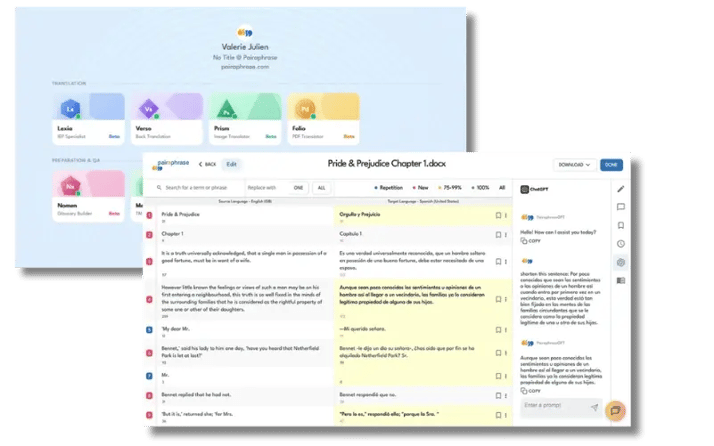
Pairaphrase is secure, document-first AI Translation Management System for governed workflows. It also offers enterprise-ready capabilities such as Single sign-on (SSO) , Role-based access control (RBAC) , granular permissions and audit logging for organizations that need centralized control across teams and recurring translation workflows.
Why Pairaphrase stands out
- 30+ supported file formats
- 160+ supported languages
- Word, Excel, PowerPoint, PDF and other file workflows
- OCR for scanned and image-based documents
- Automatic File Formatting for supported content
- Translation Memory and shared Glossaries
- Multiple supported AI and Machine Translation options
- Human review and reviewer roles
Its core workflow connects complete file translation with reusable linguistic assets, controlled collaboration and final multilingual file delivery.
Customer-reported result
Pleasanton Unified School District reported a 93% reduction in translation cost per word, $186,000 in annual savings and 800+ hours saved per year using Pairaphrase for recurring document translation.
Potential tradeoff
Pairaphrase is not primarily designed for developer-first continuous localization involving repositories, branching and software-release pipelines.
Teams centered on those workflows may prefer Crowdin, Lokalise or Phrase.
Pricing structure
Pairaphrase publishes annual plans beginning at $3,420, with larger plans available for higher-volume, multi-engine and enterprise requirements.
Sources reviewed
Pairaphrase Supported File Formats · Pairaphrase Supported Languages · Pairaphrase Security · Pairaphrase Pricing & Plans · Pleasanton Unified School District Case Study
2. Smartling: Best for enterprise content localization across connected systems

Best for
Enterprises managing multilingual content across websites, CMS platforms, marketing systems and other connected content sources.
Smartling is an enterprise Translation Management System and orchestration platform combining AI, Machine Translation, integrations, quality tools, web localization and human language services.
Why Smartling stands out
- Enterprise translation orchestration
- Broad CMS and technology integrations
- Website localization
- AI and MT workflows
- Linguistic Quality Assurance
- Translation analytics
- Professional language services
Smartling is designed to connect translation to a broader enterprise content stack rather than treating localization as an isolated file handoff.
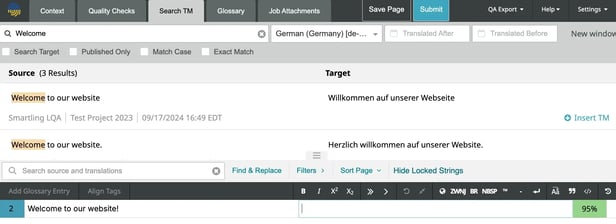
Smartling translation editor. Screenshot source: Smartling
Potential tradeoff
Organizations focused mainly on recurring documents and internal reviewer workflows may not need the same level of connected-content infrastructure and localization orchestration.
Pricing structure
Smartling combines platform offerings with usage- and translation-service pricing. Translation usage starts at $0.0075/word for MT, $0.06/word for AI Translation, $0.12/word AI + human, and $0.20/word human translation. Enterprise is custom.
Sources reviewed
Smartling Translation Management System · Smartling AI Hub · Smartling Plans & Pricing · Smartling Security
Want a closer workflow comparison?
3. Phrase: Best for combining TMS, localization and Language AI
Best for
Localization organizations that need a full TMS alongside software localization, Language AI, automation and broader localization infrastructure.
Phrase TMS is part of the Phrase Language Intelligence Platform. It combines translation project management, Translation Memory, term bases, AI and MT, vendor workflows, quality management and reporting.
Why Phrase stands out
- Full enterprise TMS
- Phrase Language AI
- Multiple MT and LLM options
- Software localization through Phrase Strings
- Translation Memory and terminology management
- Workflow automation
- Vendor management
- Localization analytics
Phrase supports documents as well as software, web and broader localization workflows.
Potential tradeoff
Organizations primarily translating recurring files with departmental reviewers may not need the wider localization ecosystem and product infrastructure Phrase provides.
Pricing structure
Phrase offers multiple plan levels, including a team plan for $14,940/year. Business and Enterprise are custom.
Sources reviewed
Phrase TMS · Phrase Language Intelligence Platform · Phrase Pricing · Phrase Security
Evaluating Pairaphrase and Phrase?
4. Lokalise: Best for product and digital-content localization

Best for
Product, engineering, design and localization teams managing multilingual apps, websites, software and digital experiences.
Lokalise is an AI localization platform centered on product and digital-content workflows. It combines translation-management functionality with branching, integrations, design workflows and automation.
Why Lokalise stands out
- Product and software localization
- Developer integrations and APIs
- Branching
- Design localization
- AI translation
- Translation Memory and terminology management
- Automated workflows
- Digital-product localization
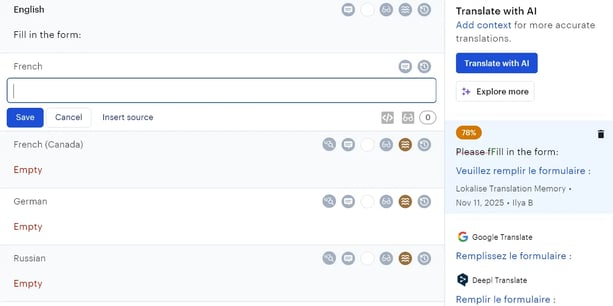
Lokalise translation editor. Screenshot source: Lokalise
Potential tradeoff
Organizations whose main deliverable is a reviewed Word document, spreadsheet, presentation or PDF may not need product-localization features such as branching and release-oriented workflows.
Pricing structure
Lokalise’s current model combines processed-word usage with advanced seats. Plans start at $1,788/year.
Sources reviewed
Lokalise Platform · Lokalise Pricing · Lokalise 2026 Pricing Documentation · Lokalise Security & Compliance
Comparing document translation with product localization?
5. Crowdin: Best for developer-led continuous localization

Best for
Software and product teams connecting translation closely to repositories, applications, websites and release workflows.
Crowdin is an AI-powered localization platform with a particularly strong developer ecosystem and extensive integrations.
Why Crowdin stands out
- Repository-connected localization
- Software, app and web translation
- APIs and developer tools
- Branching
- Continuous localization
- MT and AI integrations
- Broad integration ecosystem
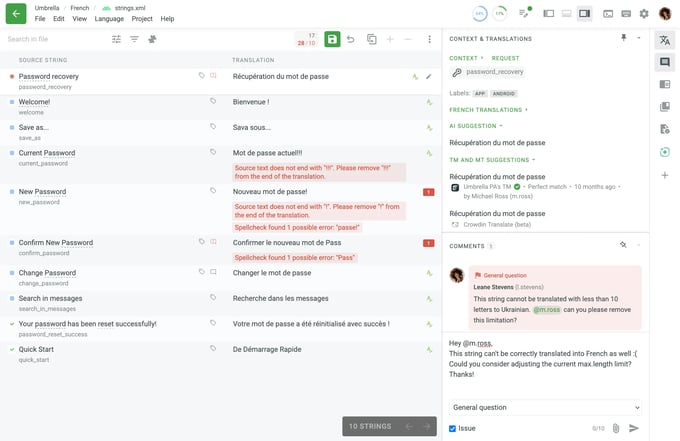
Crowdin translation editor. Screenshot source: Crowdin
Potential tradeoff
Its development-centered flexibility can introduce technical workflow functionality that departments primarily translating recurring business files may not need.
Pricing structure
Crowdin publishes self-service plans alongside organization and enterprise options. Pricing for paid, non-custom plans ranges from $550 to $5,000 annually. Crowdin also offers a customizable Business plan for larger organizations.
Sources reviewed
Crowdin Localization Platform · Crowdin Pricing · Crowdin Security
Deciding between document translation and continuous localization?
6. XTM: Best for mature enterprise localization operations

Best for
Localization organizations that need extensive workflow automation, project administration, vendor coordination an operational reporting.
XTM provides enterprise TMS technology as part of a broader localization platform designed around complex global workflows.
Why XTM stands out
- Translation project management
- Workflow automation
- Translation Memory
- Terminology management
- Quality controls
- Vendor coordination
- Enterprise reporting
- Localization integrations
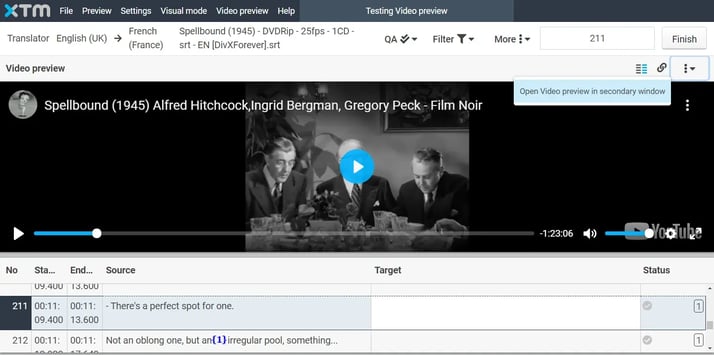
Video preview in XTM Workbench. Screenshot source: XTM
Potential tradeoff
Organizations with more straightforward document-centered workflows may not require the same depth of vendor administration, localization operations and configurable infrastructure.
Pricing structure
XTM publishes TMS-specific plans and also offers customized pricing for broader platform deployments. Pricing starts at $16,500/year. Enterprise is custom.
Sources reviewed
XTM Translation Platform · XTM TMS Pricing · XTM Platform Pricing
7. memoQ TMS: Best for linguist- and LSP-centered translation workflows

Best for
Language service providers and professional translation teams where linguists and reusable linguistic resources sit at the center of translation management.
memoQ TMS combines AI-assisted translation with Translation Memory, terminology, professional CAT workflows and configurable localization processes.
Why memoQ TMS stands out
- Professional translator workflows
- CAT functionality
- Translation Memory
- Terminology management
- AI-assisted translation
- Configurable project workflows
- Strong LSP use cases
- Human translation-centered processes
memoQ explicitly describes human translation as remaining at the center of its approach, including human checking and approval of generative-AI translation output.
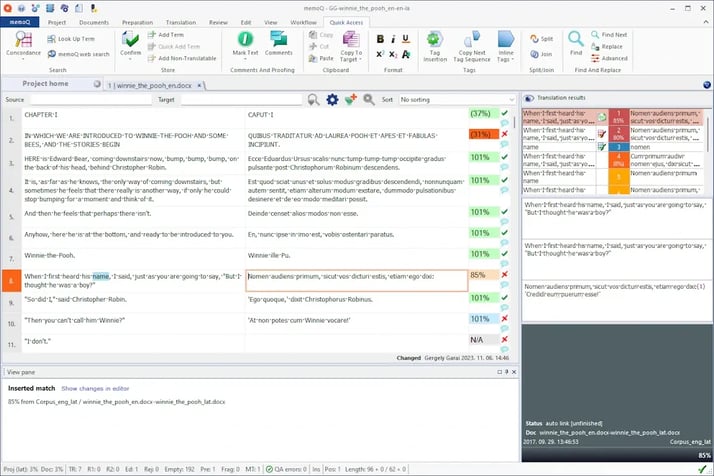
memoQ Translation editor. Screenshot source: memoQ
Potential tradeoff
Organizations involving large numbers of departmental or occasional reviewers may prioritize workflows optimized for broader business-user participation rather than professional localization operations.
Pricing structure
memoQ offers Starter, Essential, Professional and Enterprise TMS configurations. Higher tiers are quote-based.
Sources reviewed
8. Smartcat: Best for AI translation with linguist sourcing and procurement
Best for
Organizations that want AI translation, external language professionals and vendor-management workflows connected in one environment.
Smartcat combines TMS functionality with AI coworkers, translation workflows, a large professional marketplace and vendor-management capabilities.
Why Smartcat stands out
- AI translation and AI coworkers
- Translation Memory and terminology
- File and multimedia translation
- Human review
- Marketplace with 500K+ language professionals
- Vendor collaboration
- Procurement and payments
- Enterprise integrations
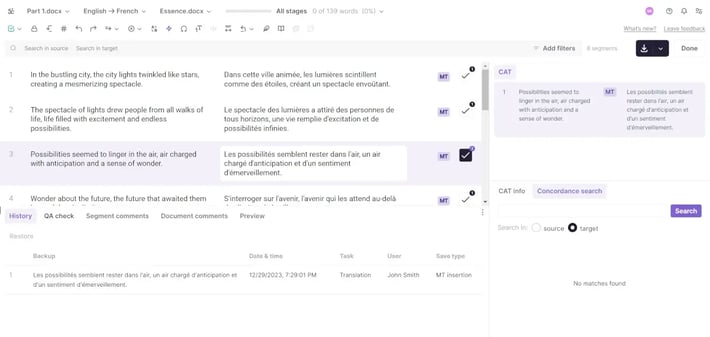
Smartcat editor. Screenshot source: Smartcat
Potential tradeoff
Organizations that already have internal reviewers, approved LSPs or established vendor relationships may not need an integrated marketplace and procurement layer.
Pricing structure
Smartcat currently uses consumption-based annual pricing. Published plans begin at $1,200 per year, with higher tiers adding AI coworkers, reviewer workflows and enterprise capabilities.
Sources reviewed
Smartcat Translation Management System · Smartcat Marketplace · Smartcat Pricing Plans · Smartcat Security
Comparing document-first translation management with Smartcat's marketplace model?
9. Trados Enterprise: Best for highly customized enterprise localization

Best for
Large localization programs that need deeply configurable translation processes and integration with the wider Trados ecosystem.
Trados Enterprise is an enterprise-scale AI-powered TMS designed for customized localization environments.
Why Trados Enterprise stands out
- Configurable enterprise workflows
- Enterprise translation management
- Trados Studio integration
- Linguistic AI
- APIs and connectors
- Professional translation workflows
- Project traceability
- Flexible localization infrastructure
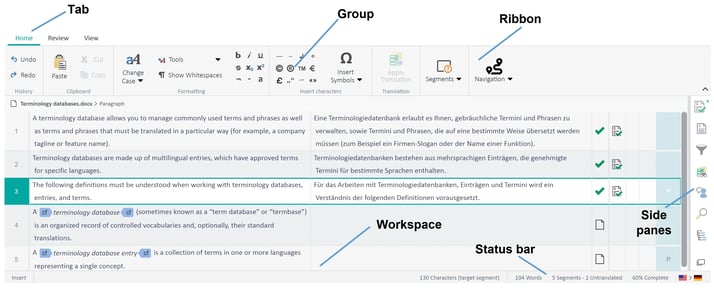
Trados online editor. Screenshot source: Trados
Potential tradeoff
Highly configurable localization environments can require more implementation and specialized localization expertise than focused document workflows need.
Pricing structure
Enterprise pricing is customized.
Sources reviewed
Trados Enterprise · Trados Enterprise Product Resources
10. GlobalLink TMS: Best for large-scale integrated localization operations

Best for
Large organizations managing translation across enterprise systems, internal teams, external suppliers and broader language-service operations.
GlobalLink TMS is TransPerfect's enterprise Translation Management System, combining centralized workflows, automation, integrations and human-plus-AI operations.
Why GlobalLink TMS stands out
- Enterprise localization management
- Workflow automation
- System integrations
- Translation Memory
- Human + AI operations
- Language-service integration
- Large-scale stakeholder coordination
Potential tradeoff
Its broad enterprise and language-services ecosystem may exceed the requirements of organizations primarily managing recurring internal document translation.
Pricing structure
Enterprise pricing is customized.
Sources reviewed
GlobalLink TMS · GlobalLink TMS 2026 Platform Update
How to compare AI translation capabilities in a TMS
AI capability alone is no longer enough to meaningfully distinguish Translation Management Systems.
Nimdzi's 2026 research found that 81.1% of surveyed language providers offer Machine Translation Post-Editing, 72% offer editing of AI-generated content and 70.3% offer AI-generated translation.
Source: Nimdzi 100 2026
The better buyer question is: How does AI fit into the organization's translation workflow?
Compare these AI capabilities
- Available AI and MT engines
- Ability to switch or route between providers
- Translation Memory integration
- Terminology enforcement
- Human review
- AI quality evaluation
- Data-training policies
- Provider retention policies
- Administrator controls
- Workflow auditability
- Complete-file support
How leading TMS platforms approach AI
| Platform | AI Workflow Emphasis |
| Pairaphrase |
PairaphraseGPT, AI Sandbox, AI Translation Assistant and supported AI/MT engines connected to document workflows |
| Smartling |
AI Hub with multiple LLM/MT options connected to enterprise content workflows |
| Phrase |
Phrase Language AI across TMS and localization products |
| Lokalise |
AI-assisted localization using project and product context |
| Crowdin |
AI within continuous localization and developer workflows |
| XTM |
AI-assisted translation, quality and enterprise localization |
|
memoQ |
Generative AI and MT connected to professional linguist review |
| Smartcat |
AI coworkers, translation automation and expert review |
| Trados |
Linguistic AI integrated with enterprise localization |
| GlobalLink |
AI routing and human-plus-AI localization operations |
Pairaphrase's AI capabilities are particularly oriented toward keeping AI-assisted translation connected to complete files, formatting, Translation Memory, Glossaries and human review.
Sources: Pairaphrase AI Translation Tools · Pairaphrase Data Handling & Governance
AI-Assisted Translation Workflow
Note: Illustrative workflow. Actual steps and capabilities vary by TMS platform.
What security and governance controls should you compare in a TMS?
Security is an enterprise requirement across the TMS category, not a capability unique to Pairaphrase.
Leading platforms including Smartling, Phrase, Lokalise, Crowdin, Smartcat and others maintain significant security and access-control programs. Buyers should compare the specific controls, plan availability, contractual terms and compliance scope relevant to their intended workflow.
Security requirements to evaluate
| Requirement | What Buyers Should Verify |
|
Encryption |
Protection in transit and at rest |
|
MFA |
Stronger authentication options |
|
SSO |
Identity-provider support and plan availability |
|
RBAC |
Roles and administrative separation |
|
Granular permissions |
File-, project- or resource-level controls |
|
Audit logging |
Which user and workflow activities are recorded |
|
AI data handling |
Training and retention policies |
|
Data residency |
Available storage and processing regions |
|
Data deletion |
Retention and deletion controls |
|
Compliance |
Exact certification, alignment or contractual scope |
Pairaphrase security controls
Pairaphrase documents controls including encryption in transit and at rest, MFA, SAML-based SSO, RBAC, granular permissions and user-action audit logging.
These controls can support governed translation workflows by centralizing access, improving auditability and maintaining human review around sensitive multilingual content.
What should regulated organizations look for in a TMS?
Regulated and data-sensitive organizations should evaluate Translation Management System workflow controls and compliance requirements together.
The appropriate platform depends on the information being translated, who can access it, applicable contracts and regulations, and how AI and human review are incorporated into the workflow.
Healthcare translation workflows
Healthcare organizations should evaluate:
- BAA availability
- PHI handling
- Encryption
- RBAC and granular permissions
- Audit logging
- AI-provider data practices
- Human review
- Data-retention policies
A healthcare organization should verify that the vendor and specific deployment can meet its contractual and HIPAA-related obligations before processing PHI.
Education translation workflows
Schools and education organizations should evaluate:
- FERPA-sensitive student information
- IEP and 504 Plan workflows
- Institutional user controls
- Reviewer permissions
- Human review
- File formatting
- Terminology consistency
- Activity visibility
Education buyers should confirm how student information, user permissions and third-party AI processing are handled within the proposed workflow.
LSP translation workflows
Language service providers may need to combine:
- AI and MT
- Machine Translation Post-Editing (MTPE)
- Translation Memory
- Terminology
- File-format handling
- Professional linguists
- Client reviewers
- Enterprise security requirements
The right TMS will depend on whether the LSP primarily manages professional linguists, enterprise localization projects, recurring client files, vendor networks or a combination of these.
Pairaphrase is one option for healthcare, education and LSP teams managing recurring sensitive documents. It combines file translation, human review, granular access controls, auditability and reusable linguistic assets, and can support BAA-based healthcare workflows and FERPA-aligned education deployments when appropriately configured.
Relevant Pairaphrase resources:
Healthcare Translation Software ·AI Translation Software for Schools & Education ·AI Translation Management Software for LSPs
HIPAA, FERPA, GDPR, PCI DSS, ISO 27001 and SOC 2
These terms should not be treated as interchangeable.
When evaluating vendors, distinguish between:
- Formal certification
- Independent attestation
- Contractual compliance support
- Alignment with relevant controls
- Product functionality that supports a compliant workflow
Confirm each vendor's current certification status, contractual commitments, product scope and customer responsibilities before processing regulated or sensitive data.
How important is TMS ease of use?
The most feature-rich TMS is not automatically the best fit for the people using it.
Advanced project controls matter for localization managers. For healthcare employees, educators, HR specialists, and occasional subject-matter reviewers, the bigger priority is often a simple, guided review process.
Evaluate whether users can easily:
- Upload and translate files
- Find assigned work
- Apply approved terminology
- Review AI-generated translations
- Collaborate without email handoffs
- Work without full administrative access
- Export a usable final file
Some platforms are optimized for localization specialists and developers, while others make broader departmental participation easier.
Pairaphrase emphasizes browser-based file workflows and reviewer roles for organizations where subject-matter experts and departmental users participate alongside translation professionals.
The relevant question is not simply “Which TMS is easiest?”
It is:
Which TMS has the right level of complexity for the people and workflows our organization actually needs?
What is Translation Management Software?
Translation Management Software, commonly called a Translation Management System or TMS, centralizes the workflows organizations use to translate, review, reuse and manage multilingual content.
Common TMS capabilities include:
- AI and Machine Translation
- Translation Memory
- Terminology management
- Human review
- Collaboration
- Workflow automation
- User permissions
- File and content management
- Integrations
- Reporting
Different TMS platforms emphasize different combinations of these capabilities. For a deeper explanation of TMS architecture, terminology and workflows, see:
Translation Management Systems: Essential Guide
How to choose the best Translation Management Software
The longest feature list does not necessarily indicate the best platform. Start with the work your organization actually needs to manage.
1. What do you translate most often?
For documents and files, prioritize:
- Supported file types
- Formatting preservation
- OCR
- Batch translation
- Translation Memory
- Terminology
- Review
- Final export
For software and digital products, prioritize:
- Repository integrations
- APIs
- Branching
- UI context
- Automated synchronization
- Continuous localization
2. Who needs to use the TMS?
Your users may include:
- Localization managers
- Translators
- LSPs
- Subject-matter experts
- Healthcare professionals
- Educators
- HR teams
- Legal reviewers
- Departmental staff
Choose a system whose workflow complexity matches the people participating in translation and review.
3. How will AI be governed?
Evaluate:
- AI and MT provider options
- Administrator controls
- Model-training policies
- Data retention
- Human review
- Translation Memory
- Terminology
- Auditability
- Approval workflows
AI governance becomes particularly important when multilingual content includes patient information, student records, legal material or confidential business data.
4. Does the TMS preserve document formatting?
Translated text can expand or contract and affect:
- Tables
- Slides
- Forms
- Text boxes
- Headers and footers
- Designed layouts
- Right-to-left content
Ask vendors exactly which elements are supported and how translated files are reconstructed before delivery.
5. Can you reuse approved translations?
Translation Memory can reduce repeated translation and help maintain consistency across recurring content.
Ask:
- Who owns the Translation Memory?
- Can it be exported?
- Can teams share it?
- Does reviewed content update it?
- How are exact, context and fuzzy matches handled?
6. Can you control terminology?
Terminology management can standardize:
- Product names
- Medical terminology
- Academic language
- Technical terms
- Legal phrasing
- Brand terminology
The most useful system connects approved terminology directly to translation and review.
7. How much localization infrastructure do you need?
More infrastructure is not automatically better.
Broad orchestration makes sense for teams managing repositories, CMS integrations, vendors, and continuous releases. For healthcare teams, school districts, and business departments, the priority is more practical: translate recurring documents securely, preserve formatting, support review, and help users get started quickly.
Questions to ask every TMS vendor during a demo
Content and workflow
- Which file and content types does the platform handle natively?
- What formatting is preserved after translation?
- Does the platform support scanned documents and OCR?
- Can reviewers participate without full administrative access?
AI and linguistic assets
- Which AI and Machine Translation engines can we use?
- Can administrators control which AI providers users access?
- Is customer content used to train AI models?
- How long do AI providers retain content?
- Who owns our Translation Memory and terminology resources?
- Can we export those assets if we change vendors?
Security and compliance
- Does the system support MFA and SSO?
- How granular are user permissions?
- Which actions appear in audit logs?
- Can the vendor sign a BAA when PHI is involved?
- What FERPA-related workflows or agreements are available?
- What GDPR, PCI DSS, ISO 27001 or SOC 2 documentation applies?
Cost and implementation
- Does pricing depend on users, words, AI usage or projects?
- Which features require higher tiers or add-ons?
- What onboarding and migration services are included?
- How long does implementation usually take for a workflo w like ours?
Related resource: Translation Management Software Buyer's Guide & Checklist
TMS vs. standalone AI translation tools
Standalone AI and Machine Translation services increasingly support both text and complete-file translation.
A TMS adds a broader management layer around translation.
| Standalone Translation | Translation Management |
|
Generate translated text |
Manage recurring translation workflows |
|
Translate a file |
Coordinate files through review and approval |
|
Apply terminology |
Manage terminology across teams |
|
Generate AI output |
Govern AI inside organizational workflows |
|
Edit one result |
Coordinate multiple reviewers |
|
Call an API |
Integrate translation into larger processes |
|
Download output |
Manage delivery and reusable language assets |
For occasional translation, a standalone translation service may be sufficient.
For recurring multilingual work involving users, sensitive files, approved terminology, Translation Memory and human review, a TMS can provide the management layer needed to make translation repeatable.
What about DeepL? Is DeepL a TMS?
DeepL increasingly appears in TMS buying conversations because its Language AI products extend beyond basic text translation into documents, APIs, terminology and workflow functionality.
The boundary between standalone Language AI and Translation Management Software is becoming less absolute as direct translation platforms add more workflow capabilities.
The buying question is therefore whether your organization primarily needs DeepL's Language AI environment or a broader TMS designed to coordinate translation engines, users, files, linguistic assets and recurring organizational workflows.
Pairaphrase includes DeepL as one supported translation-engine option within its broader document translation-management environment.
Comparing DeepL with broader translation management?
Which Translation Management System should you choose?
There is no universally best Translation Management System. Choose based on the workflow your organization needs to manage.
- Consider Pairaphrase if recurring documents, formatting preservation, terminology, human review and secure AI translation for governed workflows are central to your needs.
- Consider Smartling if translation spans websites, CMS platforms and broader connected enterprise content systems.
- Consider Phrase if you need TMS, software localization and Language AI within a broader localization ecosystem.
- Consider Lokalise if product, design and digital-content localization drive your workflow.
- Consider Crowdin if repositories and continuous software localization are central.
- Consider XTM if you operate a mature localization function requiring extensive automation and reporting.
- Consider memoQ if professional linguists and CAT-tool workflows are central to translation operations.
- Consider Smartcat if external linguist sourcing and vendor management are major requirements.
- Consider Trados Enterprise if you need a highly configurable enterprise localization environment.
- Consider GlobalLink if you operate large-scale localization connected to enterprise systems and language services.
Frequently asked questions
What is the best Translation Management Software in 2026?
There is no single best TMS for every organization.
Pairaphrase is best for secure, document-first AI translation management for governed workflows. Crowdin and Lokalise are strong for continuous digital-product localization, while Smartling, Phrase, XTM, GlobalLink and Trados support broader enterprise localization operations.
What TMS is best for document translation?
Pairaphrase is a strong fit for organizations translating recurring Word, Excel, PowerPoint, PDF and other files that require formatting preservation, Translation Memory, terminology control and human review.
Buyers should also evaluate security, integrations, language coverage and organization-specific requirements.
What TMS is best for enterprise organizations?
It depends on how the enterprise manages multilingual content.
Pairaphrase is an enterprise-ready option for recurring document translation across departments and reviewers, while Smartling, Phrase, XTM, GlobalLink and Trados may fit broader localization environments involving connected content systems, software localization or extensive global operations.
What TMS is best for healthcare organizations?
Healthcare buyers should evaluate PHI handling, BAA availability, permissions, auditability, AI-provider data practices and human review.
Pairaphrase is one option for recurring healthcare document workflows and can enter into a BAA with eligible customers processing PHI.
Explore Pairaphrase Healthcare Translation Software
What TMS is best for schools and education?
Education buyers should evaluate FERPA-sensitive data handling, IEP and file workflows, reviewer permissions, terminology, auditability and human review.
Pairaphrase is particularly oriented toward recurring school and district document workflows and supports FERPA-aligned deployments.
Explore Pairaphrase Translation Software for Schools & Education
What TMS is best for LSPs?
The best TMS for an LSP depends on its operating model.
Pairaphrase is relevant to LSPs managing recurring client files, AI-assisted translation, Machine Translation Post-Editing (MTPE), terminology and formatting. memoQ emphasizes professional linguistic workflows, while Smartcat combines translation technology with linguist sourcing and vendor management.
Explore Pairaphrase Translation Management Software for LSPs
What TMS is best for software localization?
Crowdin and Lokalise are particularly strong for software and product localization.Phrase also supports software localization alongside TMS and broader Language AI workflows.
How much does Translation Management Software cost?
Translation Management Software pricing varies widely by vendor and workflow. Some platforms publish subscription tiers, while others use custom enterprise pricing.
Common pricing factors include:
- Number and type of user seats
- Translation volume or processed words
- AI or Machine Translation usage
- Included file formats and workflow features
- Security and compliance features
- Integrations, APIs, or connector access
- Human translation, review, or language services
- Onboarding, migration, or implementation support
Some vendors publish subscription tiers, while others use custom enterprise pricing.
What features should I look for in a TMS?
Most buyers should evaluate:
- AI and MT options
- Translation Memory
- Terminology management
- File handling
- Formatting preservation
- Human review workflows
- Security and data handling controls
- Permissions
- Audit logging
- Workflow automation
- Integrations and APIs
- Reporting
Related resource: 18 Best Translation Management System Features
Is Pairaphrase a Translation Management System?
Yes. Pairaphrase is a Translation Management System (TMS) designed for secure, document-first AI translation. It combines translation memory, terminology management, formatting preservation, collaboration and human review with enterprise access and governance controls.
It also provides enterprise-ready access and governance capabilities such as SSO, RBAC, granular permissions and audit logging. Its strongest fit is recurring multilingual document and file translation rather than developer-first continuous software localization.
Can a TMS use multiple AI or Machine Translation engines?
Yes. Some TMS platforms support multiple providers, engines or routing approaches. Pairaphrase, Smartling, Phrase, Smartcat and other TMS platforms provide different forms of multi-engine or AI-orchestration capability.
Is using a TMS more secure than using standalone AI translators?
Not automatically. Security depends on the vendor, configuration, access controls and data-handling policies.
A TMS can add centralized permissions, auditability, Translation Memory, terminology management and review controls that may be difficult to coordinate when employees use disconnected translation tools independently.
What should regulated organizations look for in a TMS?
Compliance-sensitive organizations should evaluate:
- Encryption
- MFA and SSO
- RBAC
- Granular permissions
- Audit logging
- AI-provider data handling
- Data retention policies
- Human review workflows
- FERPA requirements
- GDPR requirements
- Applicable PCI DSS controls
- ISO 27001 and SOC 2 certifications, attestations or aligned practices
Verify every vendor's current contractual commitments and compliance scope before processing regulated information.
Next Step
Explore Pairaphrase, a secure, document-first translation management system (TMS) for organizations managing recurring multilingual files.
Get governed AI translation and human review without the complexity of broader enterprise localization workflows.


