

/PairaVoice-Start-A-Conversation-nobg-md.png?width=200&height=300&name=PairaVoice-Start-A-Conversation-nobg-md.png)















.png)

.png)

 ChatGPT
 Google AI
 Perplexity
 Claude
 Grok
GrokIf you’re searching for the best AI writing assistant for translation, it’s important to know that AI Translation is most effective when it’s deployed in a translation-first workflow with governance, terminology control, and formatting fidelity.
Multilingual content isn’t a “nice to have,” it’s revenue-critical. In fact, 76% of customers across 29 nations prefer to buy products that offer information in their own language. As a consumer yourself, this shouldn’t come as a surprise.
We all prefer shopping experiences that make our purchase decisions fast and effortless.

Why take our advice on finding the best AI writing assistant for translation?
As veterans who have been in the language translation industry for decades, we’ve helped organizations across various industries and sectors with translation and content localization. This includes teams that have to adhere to specific regulations, such as in healthcare, education, finance, government, and manufacturing.
With our AI Translation Management System, we’ve helped organizations leverage tools such as Translation Memory (TM), Terminology Management, and Language Quality Assurance. Not to mention, we always place emphasis on human-in-the-loop review.
In summary, our recommendations below are field-tested, not theoretical. For responsible AI, we align with the NIST AI Risk Management Framework so your program has controls, not just prompts.
What you’ll learn in this article
-
What sets the best AI writing assistants apart: How an AI writing assistant for translation differs from general writers—domain/style controls, terminology, compliance.
-
Where Pairaphrase fits: How the AI Sandbox plugs into governed, multilingual workflows.
-
Your 7-point checklist: Features, governance, compliance, terminology, engine choice.
-
Head-to-head comparison: General-purpose AI translation tools vs. Pairaphrase AI Sandbox—focus, terminology, compliance.
-
FAQs: Direct answers on accuracy, security, Transcreation vs. MT, and ChatGPT vs. Sandbox.
Why translation needs a specialized AI writing assistant
High fluency isn’t the same as high-fidelity translation.
-
Context & tone: Domain, audience, and style controls prevent drift in specialized content.
-
Terminology accuracy: Enterprises live and die by correct terms—the ability to upload a custom Terminology Database (Term Base) is non-negotiable, aligned with translation standards.
-
Compliance: If you handle PHI, student records, or EU personal data, you need documented safeguards (HIPAA Security Rule, FERPA, GDPR) and an auditable Translation Management System.
-
Human-in-the-loop: Machine Translation Post-Editing is the enterprise norm (see ISO 18587, with ISO 17100 as the core Translation Services standard).
Why general AI writing tools don’t solve multilingual workflows
When you evaluate an AI writing assistant for translation, check for terminology control, formatting preservation, and auditability. These are capabilities that general AI writers and single-feature translation widgets usually lack.
-
DeepL Write Pro: a strong writing assistant; DeepL also ships Clarify for disambiguation—but Write Pro isn’t a Translation Management System.
-
Type.ai: a well-positioned long-form AI editor; it doesn’t have terminology governance.
-
Lokalise: a robust localization platform with AI translation flows and API/webhooks; great automation, but a different focus than a translation-first writing sandbox.
-
Built-ins (e.g., CMS translation buttons): convenient, but still not a translation program. Example: HubSpot’s DeepL-powered automatic translation is helpful, yet separate from terminology governance.
7 Features to Look for in the Best AI Writing Assistant for Translation & Multilingual Content
1. Translation-specific GPT
You need a model that can be trained on domain, audience, style, and respects Segments and Translation Units, so Source Language → Target Language fidelity holds. This also enables predictable tone and register across releases—so legal notices don’t read like ads (and vice versa).
Pro tip: If a vendor can’t show how their system enforces a Terminology Database during multilingual content generation (or via a refine pass), you’re buying risk, not speed.
2. Multilingual content creation (not just post-hoc MT)
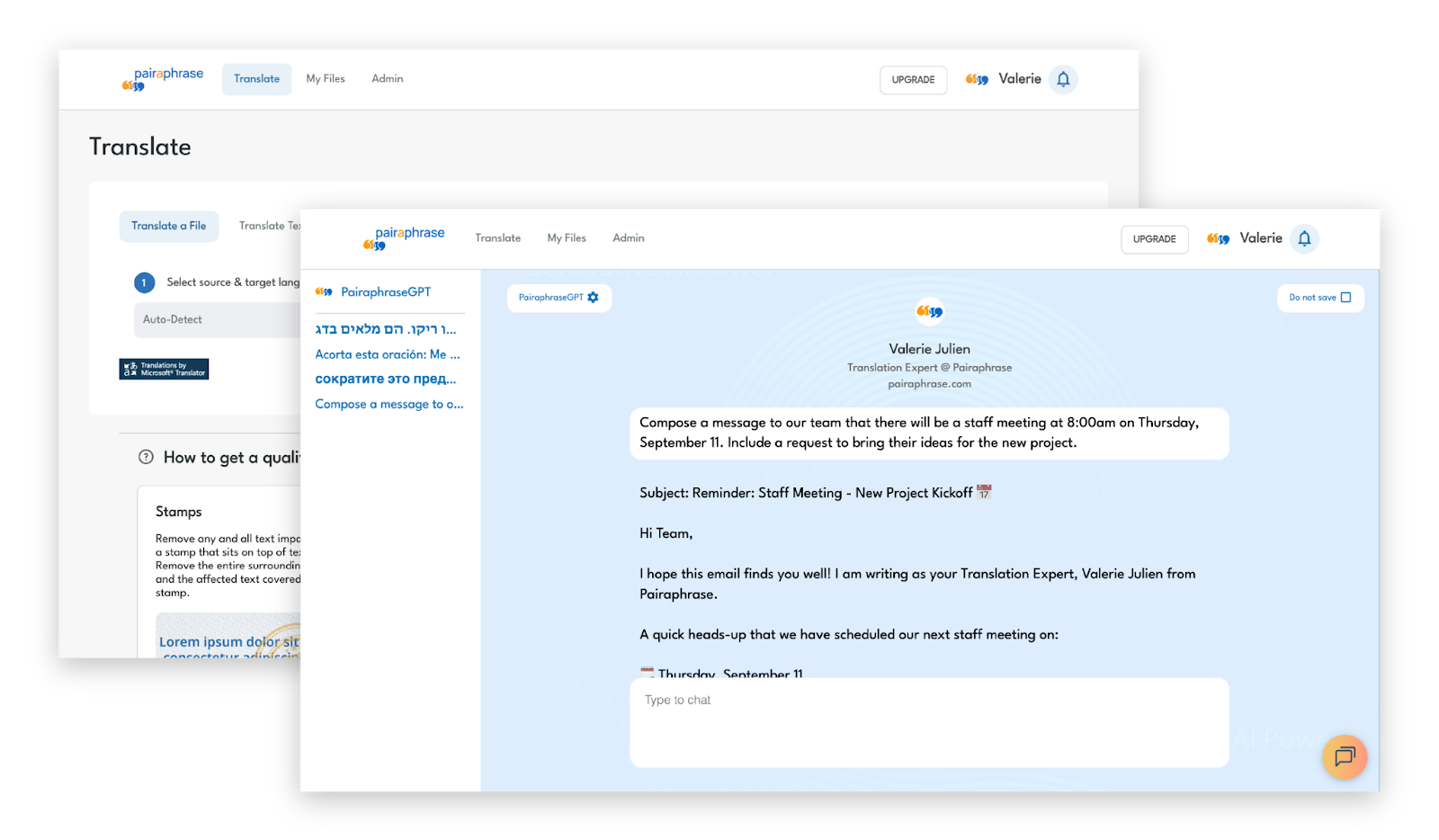
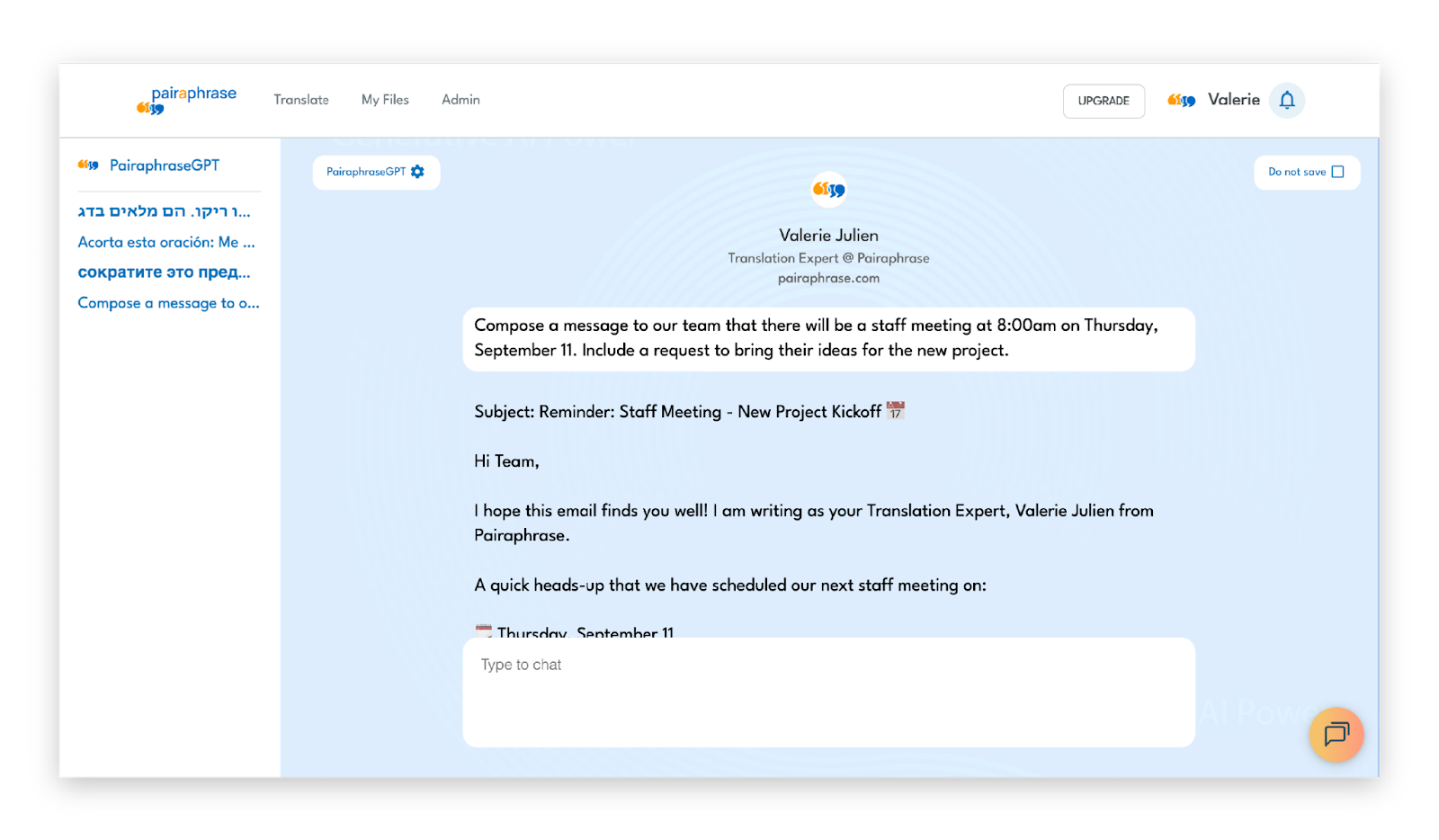
Create original multilingual drafts and Transcreation variants in one secure and compliant workspace. For example, Pairaphrase’s AI Sandbox is built for prompt-based generation and adaptation inside a governed translation environment.
One workspace means fewer copy-paste errors and a clear audit trail from draft to publish.
3. Integration with Terminology Management
A Terminology Database (Term Base) should be first-class. This aligns with ISO 17100 expectations around process and resources. Strong terminology management reduces cost and cycle time while keeping brand terms consistent across assets.
4. Security & compliance
Security and compliance is critical. Ask for SOC-2-aligned controls and support for HIPAA/FERPA/GDPR obligations, plus audit logs and role-based access. The HIPAA Security Rule explicitly calls for administrative, physical, and technical safeguards.
Make sure BAAs/DPAs are available—governance isn’t real without the right contracts. If your legal team is evaluating vendor data flows, weigh the pros and cons of translating with OpenAI for your enterprise.
5. Choice of AI engines
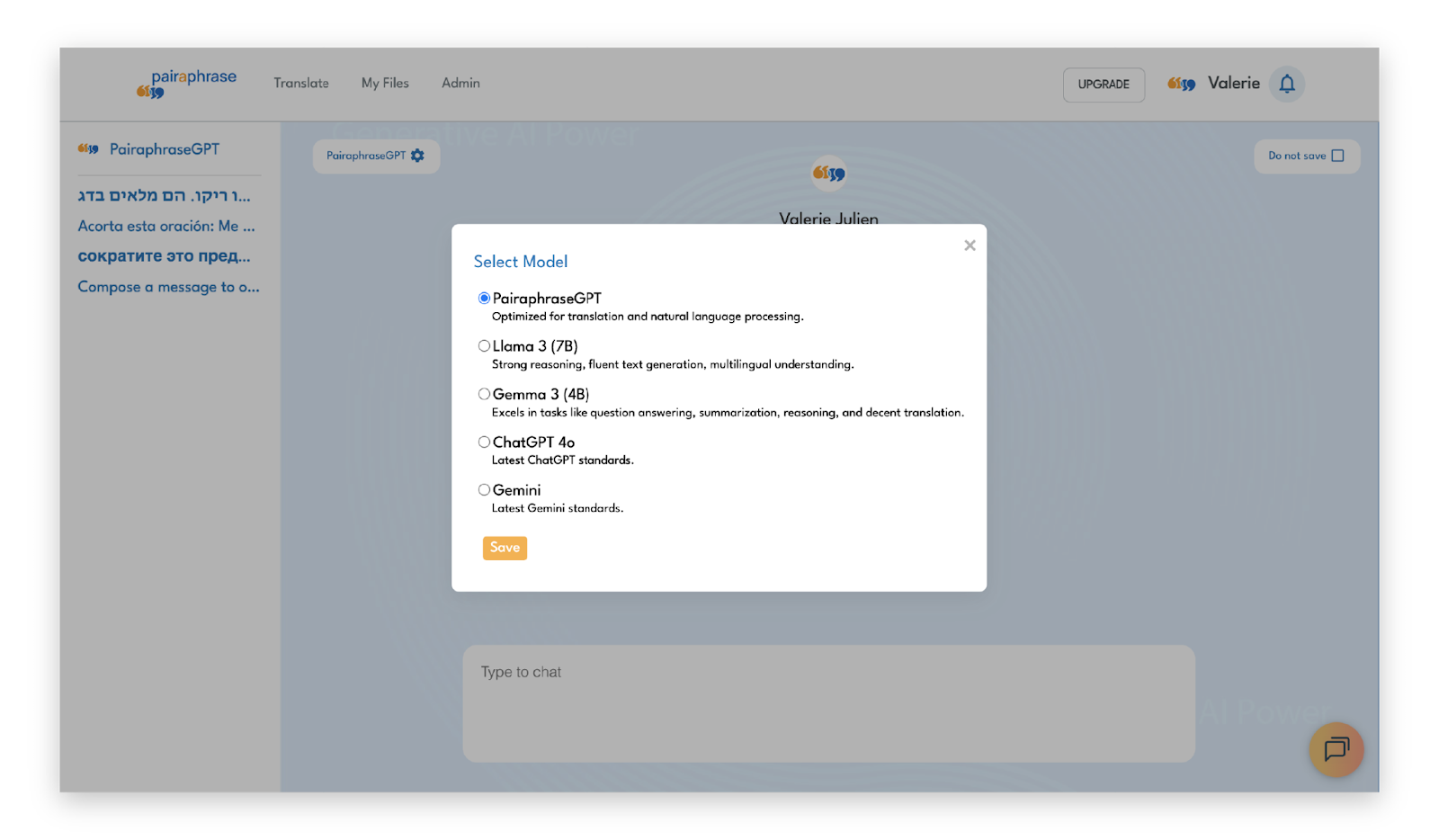
Different content and languages benefit from different engines. You want multiple LLMs available and selectable per job, with optional chains like Automatic Speech Recognition → translation → Text-to-Speech.
No single engine wins every language pair, domain, or format. That’s why the best AI writing assistant for translation lets you select and route across LLMs (e.g., ChatGPT, Gemini)—per project, per language, even per segment.
Learn more about which translation engine best fits your needs here.
6. Transcreation tools (market fit, not just literal)
Back-translation, style testing, and market-specific variants ensure brand voice travels.
Not sure how to brief tone and variants? Use our list of 35 ChatGPT translation prompts written by professional translators to adapt per language and domain.
7. Responsible AI (governance, not just prompts)
Operationalize Quality Assurance: BLEU (Bilingual Evaluation Understudy) for system-level signals, Language Growth (Text Expansion) safeguards, Right-to-Left support, and documented handling of hallucinations, mapped to NIST AI RMF.
Tie quality gates to release types (e.g., marketing vs. policy) so review depth matches risk. Look for an AI translation assistant with responsible governance baked in, not tacked on. For a balanced view of model trade-offs, see Advantages & Disadvantages of LLMs for Translation.
Introducing Pairaphrase’s AI Sandbox (your translation agent)
What it is: a Generative AI workspace inside Pairaphrase that lets your team generate, adapt, and refine multilingual content—with model choice, domain/audience/style controls, and enterprise guardrails.
What it does: create drafts, run transcreation exercises (variants, back-translations), enforce terminology—all inside an enterprise-level Translation Management System.
Bottom line: With Pairaphrase’s sandbox as your agentic translation content tool, you get governed creation—not copy-paste into a public chatbot. (Pairaphrase also supports compliance with HIPAA & FERPA.)
Why Pairaphrase is the Best AI Writing Assistant for Translation
Big platforms now display “translate” buttons—handy, but convenience isn’t a translation program.
Pairaphrase is translation-first, with TM Leverage, terminology control, formatting preservation, collaboration, and compliance—paired with an AI Sandbox that generates and adapts content within your governed workflow.
Capability matrix: Pairaphrase AI Sandbox vs. general AI writing assistants
|
Requirement |
General AI Writing Assistants (e.g., ChatGPT) |
Pairaphrase AI Sandbox |
|
Focus |
General writing (blogs, emails, posts) |
Translation, Transcreation & Multilingual content creation |
|
Translation accuracy |
Fluent but inconsistent on domain terms |
Translation-tuned LLM + domain/style controls |
|
Compliance & audit |
Minimal |
Enterprise controls, approvals, audit trails |
|
Multilingual creation |
Per-language prompts |
One secure workflow, 140+ languages |
|
Engines |
Usually one provider |
Multiple LLMs paradigms selectable per project |
|
Transcreation |
Limited tone/style |
Built-in variant testing + back-translation |
General built-in writing assistants vs. translation-first writing assistants: why it matters
CMS and marketing suites such as HubSpot increasingly offer automatic translation.
That’s helpful, but those are not Translation Management Systems. If you publish at scale across regulated markets, you need translation-first governance—and that’s where the translation-first writing assistants win.
FAQs: Best AI writing assistant for translation
What is the best AI writing assistant for translation?
For enterprise needs, the best AI writing assistant for translation is a translation-first tool with translation glossaries, transcreation, and governance—such as Pairaphrase’s AI Sandbox. General chatbots write well, but they don’t manage translation programs.
Can AI writing assistants handle multilingual content creation (not just translate)?
Yes—when creation and Translation live in one governed workspace with model choice and terminology controls; that’s the (creative) AI Sandbox approach vs. copy-pasting between public tools.
How is an AI writing assistant different from Machine Translation?
Machine Translation converts Source Text to Target Text; an assistant creates, adapts, and governs content (Transcreation variants, terminology enforcement, reviewer gates) inside a Translation Management System aligned to standards.
Is AI accurate enough for enterprise use?
Yes, AI can be accurate—when paired with Language Quality Assurance and Machine Translation Post-Editing per ISO 18587, with processes framed by ISO 17100 and risk controls from NIST AI RMF.
What security features should I require?
For security features, demand documented safeguards and auditability (admin/physical/technical), and contractual readiness for HIPAA/FERPA/GDPR where applicable; these are explicit regulatory expectations.
How does Pairaphrase’s AI Sandbox compare to ChatGPT for Translation?
ChatGPT is an excellent general writer, but Pairaphrase’s AI Sandbox adds the translation essentials—terminology control, and governed workflows with AI model choice in your TMS—making it better suited for enterprise translation.
Recommended AI Writing Assistant for Translation & Multilingual Content
Want to get started with the best AI writing assistant for translation & multilingual content generation? Try Pairaphrase. It’s the AI Translation Management System for teams that value smarter, faster and safer translation.
Pairaphrase supports 140+ languages and 20,000+ language pairs. Translate into Spanish, English, French, German, Arabic, Hindi, Chinese, Japanese, and more. Not to mention, Pairaphrase performs file translation for 25+ file types.
Just one translation with Pairaphrase can cover your annual subscription!
Get Started
Schedule a demo or share this article with a colleague.
“I love Pairaphrase! My translation team and I were able to translate all of our Business & Entrepreneurship Program curriculum in less than two months and for almost $60k cheaper than the top translation companies. The Pairaphrase team is so supportive, attentive, and always willing to work with you to meet your needs.”
- Aleece Baker, Assistant Dean of Online & International Programs @ The Joseph Business School

Reviewed by

Founder and CTO
He is Co-Founder and CTO of Pairaphrase and a leader in translation technology with more than two decades of experience improving how organizations communicate across languages. His work focuses on making multilingual communication more accurate, efficient, and accessible through AI-driven translation solutions, practical innovation, and a strong emphasis on usability, quality, and security.