

/PairaVoice-Start-A-Conversation-nobg-md.png?width=200&height=300&name=PairaVoice-Start-A-Conversation-nobg-md.png)


















.png)

.png)


 ChatGPT
 Google AI
 Perplexity
 Claude
 Grok
GrokHealthcare teams cannot afford to sacrifice data security for the sake of convenient communication.
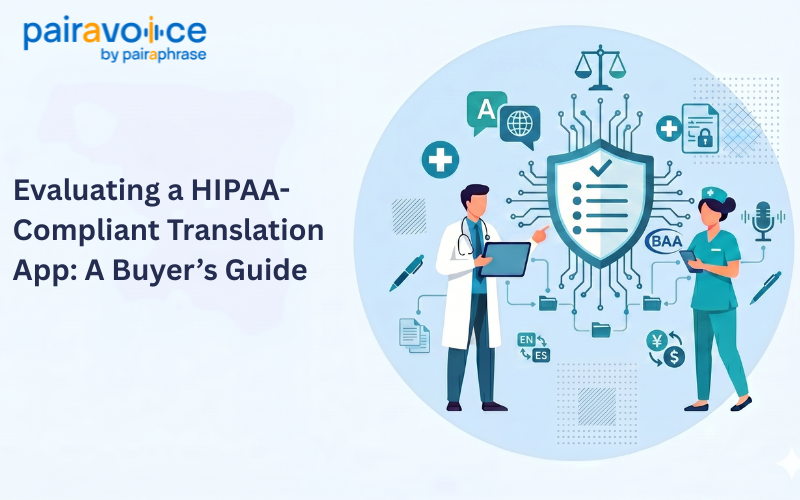
A truly HIPAA-compliant translation app must do more than just convert words between languages. It has to actively protect patient privacy while fitting into fast-moving clinical workflows.
This guide breaks down the technical standards and compliance markers your organization must verify before choosing a healthcare translation platform.
Beyond convenience: Why consumer apps fail in healthcare
Consumer translation apps are built for travelers and casual conversations. Healthcare environments demand a higher standard.
The moment a patient shares a symptom, medication history, or discharge instruction, that conversation transforms into Protected Health Information (PHI). At that point, your translation app is no longer just a language tool, but an active component of your data infrastructure.
General-purpose apps simply aren't built for clinical environments. While they process words quickly, they typically fail in three critical areas:
- Data Retention: Most free tools log and store text inputs to train their AI models. In a hospital setting, this is an automatic data breach.
- Administrative Control: IT leaders cannot audit user history, manage permissions, or securely delete past logs.
- Medical Accuracy: Casual tools lack the specialized terminology required to translate complex clinical workflows accurately.
In our guide on whether Google Translate is HIPAA compliant, we break down a question many healthcare teams ask: are their current, familiar tools actually safe for patient care?
For clinical leaders, the real question is about infrastructure: Can your app bridge the language barrier while guaranteeing total data security?
The regulatory reality: PHI and the BAA requirement
Not every translated phrase carries equal risk. A front-desk greeting like "Welcome to the clinic" does not require strict security. However, the exact moment a conversation shifts to symptoms, prescriptions, or discharge instructions, you are handling Protected Health Information (PHI).
Under HIPAA, any vendor that touches PHI must sign a Business Associate Agreement (BAA).
A BAA is a legally binding contract that transfers data liability and requires the vendor to protect patient data in accordance with federal standards. If a software provider refuses to sign a BAA, you cannot legally use their application for clinical workflows. This rule applies regardless of how accurate or fast their translation engine runs.
To ensure regulatory compliance, your legal and IT teams must audit how a translation tool handles data across four specific touchpoints:
- Temporary Capture: Is voice input or typed text immediately encrypted in transit?
- Data Retention: Are conversation transcripts and notes saved on the vendor’s servers?
- Access Control: Can administrators restrict user access and audit app usage?
- Vendor Access: Does the software vendor have any visibility into the patient logs?
Compliance represents a structural safeguard that dictates how data is processed from the moment a clinician speaks into the device until the conversation is permanently purged, ensuring data security.
Common risks in healthcare translation workflows
When software lacks clear administrative controls, medical staff naturally improvise. To save time during a hectic shift, a nurse might copy and paste a patient's medical history into a free browser app, or take a screenshot on a personal smartphone to save a translation. These temporary workarounds create immediate, unmanaged data exposures.
Free tools also introduce severe backend risks. If your vendor utilizes crowdsourced data review or uses customer inputs to train open-source AI models, your patient data is no longer private.
Our guide to the risks of free transcription software in healthcare breaks down these backend vulnerabilities in detail.
Building a secure clinical workflow requires replacing staff improvisation with explicit software parameters. Organizations must deploy platforms that lock down four operational areas:
- Data Isolation: The app must block the vendor from logging, reviewing, or repurposing conversation text.
- Device Security: The platform needs to function within a secure infrastructure, preventing staff from saving local files or screenshots to personal devices.
- Role-Based Access: System administrators must hold the power to provision, audit, and instantly revoke user access.
Essential features for healthcare workflows
A clinical translation app must balance immediate utility with absolute data security. When evaluating platforms, prioritize software that delivers on these core capabilities.
Secure real-time patient communication
Patient interactions require immediate, fluid dialogue during triage, intake, and bedside care. The platform must support instantaneous voice-to-voice and text translation to keep conversations moving naturally. Look for a mobile-first design that empowers clinicians to communicate across exam rooms, home health visits, and mobile clinics without requiring specialized, cumbersome hardware.
Protection for PHI and sensitive patient information
Compliance requires granular, enterprise-grade control over data lifecycles. Ensure your chosen app features strict data encryption both in transit and at rest to maintain data security. Administrators must possess the tools to set custom data retention policies, execute mandatory session purging, and audit user access logs.
Medical translation accuracy and clinical context
Medical terminology leaves no room for casual, word-for-word approximation. The translation engine must handle complex clinical phrasing, drug names, and precise dosage instructions accurately. While software drastically speeds up routine communication, high-risk diagnostic conversations will always require the nuanced judgment of a human interpreter.
AI note-taking and documentation support
Using automated transcription to generate clinical notes saves hours of administrative overhead, but it introduces massive privacy risks. If a platform features automated note-taking, those text summaries require the same rigid compliance vetting as the translation tool itself. Our dedicated guide on why doctors need a HIPAA-compliant AI note-taking app explores these specific documentation safety standards.
Easy patient experience
A patient navigating a language barrier is already experiencing a high-stress situation. They should never have to decipher a dense, complicated interface. A clean, dual-language conversation view with clear text scaling allows patients to read along, understand their care plan, and feel secure in their communication.
Clinical applications: Where secure translation impacts care
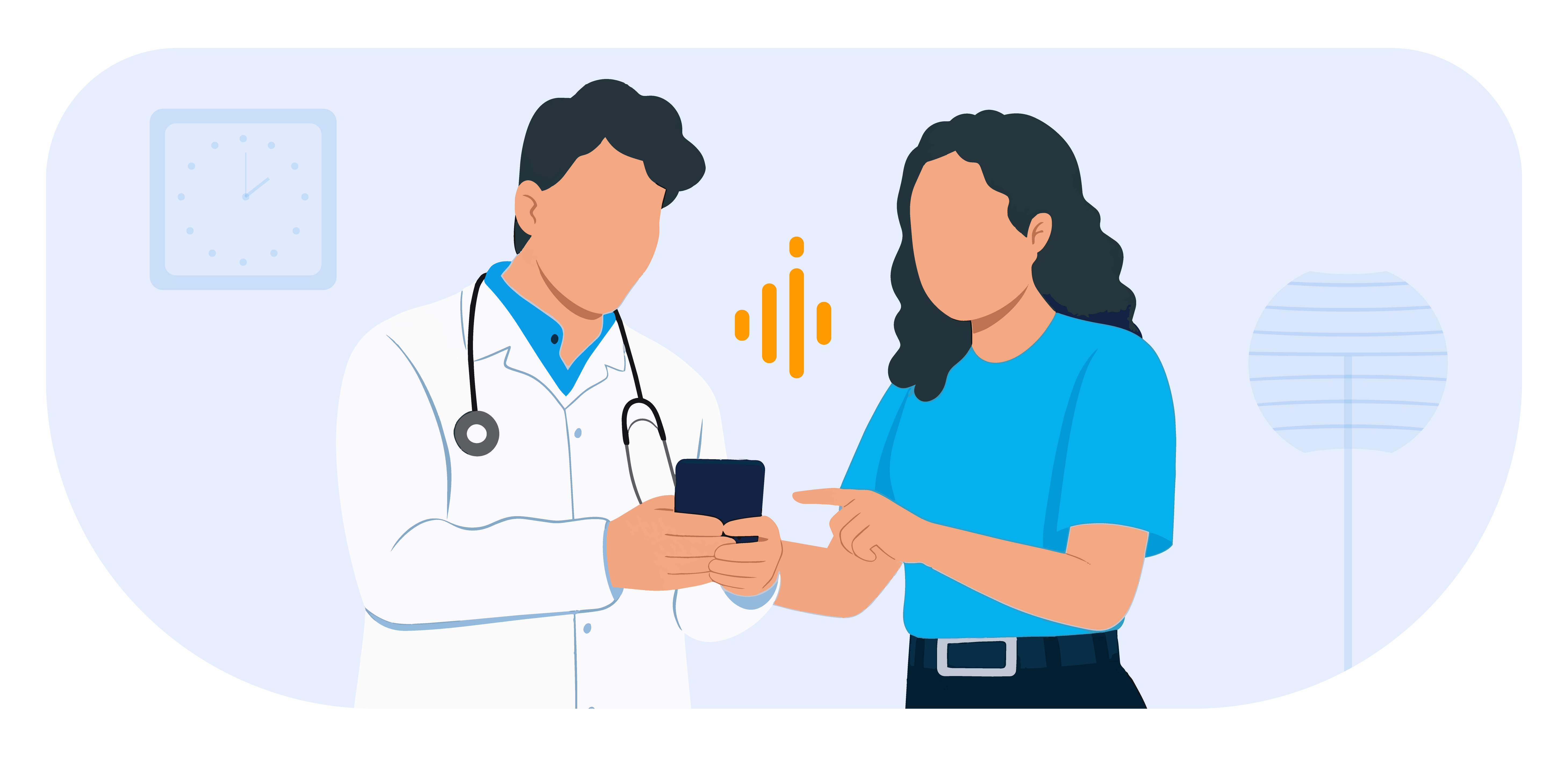
Deploying a dedicated, HIPAA-compliant app prevents staff from resorting to unmanaged, consumer-grade workarounds. In a fast-paced medical environment, secure translation technology actively optimizes patient communication across several core clinical touchpoints.
Streamlining patient intake and triage
Front-desk and registration teams utilize real-time translation to collect demographic data, verify insurance details, and process administrative paperwork safely. Once the patient moves to triage, the platform allows nursing staff to quickly assess symptoms and determine the urgency of care. This immediate communication loop ensures accurate data collection before the clinical visit even begins, allowing teams to flag high-risk cases that require an immediate human interpreter.
Eliminating confusion in medication and discharge instructions
Misunderstanding a medical directive can lead to medication errors and preventable readmissions. Clinicians use translation tools to deliver unambiguous instructions regarding dosage, timing, and potential side effects. At checkout, the software helps providers clearly explain home care steps, warning signs, and follow-up appointment schedules, ensuring the patient departs with a clear understanding of their care plan.
Extending Access to Telehealth and Remote Care
Managing language barriers becomes significantly more complex during virtual visits when an in-person interpreter is unavailable. A secure translation application integrates into digital workflows to support remote follow-up calls and telehealth consultations. This capability ensures that non-English speaking patients receive the same continuity of care as on-site patients.
Supporting untethered home health and mobile clinicians
Home health providers, elder care teams, and mobile clinicians routinely deliver care outside the traditional hospital infrastructure. Operating in rural communities or underserved settings requires lightweight, mobile-first technology.
AI translation vs. human interpreters: When should healthcare teams use each?
A modern language access strategy does not force healthcare organizations to choose a single tool for every scenario. Instead, it deploys technology to handle immediate, high-volume communication so that human interpreters can focus on high-risk clinical interactions.
Determining when to route a conversation through a secure translation app versus a human interpreter comes down to clinical risk and emotional complexity.
|
Use the HIPAA-Compliant App |
Escalate to a Human Interpreter |
|
Routine Administrative Intake Gathering demographics, insurance verification, and processing check-in paperwork. |
Informed Consent Processes Reviewing legal forms, surgical risks, and obtaining official patient signatures. |
|
Basic Clinical Triage Identifying primary symptoms, tracking pain scales, and determining immediate routing. |
Complex Diagnostic Discussions Delivering a life-altering diagnosis, oncology updates, or explaining complicated treatment plans. |
|
Standard Care Instructions Explaining routine medication schedules, dosage timing, and detailing basic checkout steps. |
High-Acuity or Crisis Care Navigating behavioral health emergencies, end-of-life conversations, or substance abuse triage. |
|
Immediate, Non-Urgent Interactions Asking for basic comfort needs, explaining facility layout, or scheduling a follow-up appointment. |
High-Nuance Clinical Reviews Any scenario where cultural context, deep emotional sensitivity, or legal liability is present. |
Relying solely on human interpreters for every single patient touchpoint creates massive operational bottlenecks and drives staff to use unapproved consumer tools during delays. Utilizing a secure, real-time application for everyday workflows preserves your interpreter budget and keeps your clinical communication fully compliant.
Questions to ask before choosing a HIPAA-compliant translation app
Evaluating a clinical translation platform requires looking past basic software metrics like language counts. Healthcare organizations must thoroughly audit vendors regarding data architecture, user permissions, and compliance liability.
Bring these specific questions to your next product demonstration:
- Is the app designed for healthcare workflows?
- Does it support real-time patient conversations?
- Does it offer speech-to-speech translation?
- Can users speak or type?
- Does it create live transcripts?
- Are transcripts saved?
- Can transcripts be searched, deleted or access-controlled?
- How does the vendor protect PHI?
- Does the app use enterprise-grade data security?
- Can administrators manage user access?
- Does the app support mobile workflows?
- Does it require external hardware?
- Does it offer documentation support?
- Does it help providers work faster without sacrificing privacy?
- When should your team escalate to a human interpreter?
If a vendor cannot provide transparent, definitive answers regarding their data handling, session storage, or encryption standards, they should be removed from your selection process. In healthcare compliance, an inability to verify data routing functions as a structural disqualifier.
How PairaVoice supports HIPAA-compliant patient communication
PairaVoice is a secure, AI-powered speech transcription and translation mobile app built for healthcare professionals who need clear communication across languages. It helps providers support multilingual patient conversations without relying on a human interpreter for every interaction.
With PairaVoice, providers can translate real-time conversations, use voice or text, view live transcripts and communicate from a mobile device without extra hardware. Hands-free use, streaming and batch modes, and documentation support help teams adapt the app to the pace and sensitivity of each conversation.
For providers who need more advanced documentation support, PairaVoice Pro adds personal note transcription, saved and searchable transcripts, and automatic SOAP note generation. That gives healthcare teams a more practical way to connect patient communication with clinical documentation while keeping privacy and workflow needs front and center.
See how PairaVoice helps healthcare teams communicate securely across languages with real-time translation, transcription, and documentation support.
FAQs
What makes a translation app HIPAA compliant?
A translation app achieves HIPAA compliance through structural security and data isolation. The platform must feature enterprise-grade encryption for data in transit and at rest, granular administrator access controls, and a mandatory zero-retention policy for patient data. Furthermore, the software vendor must assume data liability by signing a Business Associate Agreement (BAA).
Are translated patient conversations considered PHI?
Yes. The moment a translation involves identifiable health details—including symptoms, diagnoses, medication names, or billing info—the text or audio transmission constitutes Protected Health Information (PHI). Healthcare organizations must process these interactions within a secure ecosystem.
Can a HIPAA-compliant translation app transcribe patient conversations?
Yes, secure translation platforms frequently include live transcription capabilities. However, before deploying automated transcription, compliance teams must verify that the generated text files adhere to the same rigid retention, encryption, and automatic purging rules as the translation engine itself.
Do healthcare teams need a BAA for translation software?
Yes. Under federal regulations, any software vendor that creates, receives, maintains, or transmits PHI on behalf of a covered entity functions as a Business Associate. You cannot legally utilize a translation app for clinical data unless the vendor signs a BAA.
Can AI translation replace human medical interpreters?
AI translation functions as an operational supplement, not a total replacement. Real-time software safely optimizes high-volume, routine interactions like intake, triage, and standard care instructions. High-acuity scenarios, informed consent processes, and complex diagnostic reviews require the nuanced expertise of a certified human medical interpreter.
What is the best HIPAA-compliant translation app for healthcare teams?
The ideal platform balances immediate mobile utility with rigorous backend data security. For organizations requiring real-time speech translation, live secure transcription, and automated documentation support, PairaVoice is engineered specifically to meet these clinical and regulatory standards.