

















 ChatGPT
 Google AI
 Perplexity
 Claude
 Grok
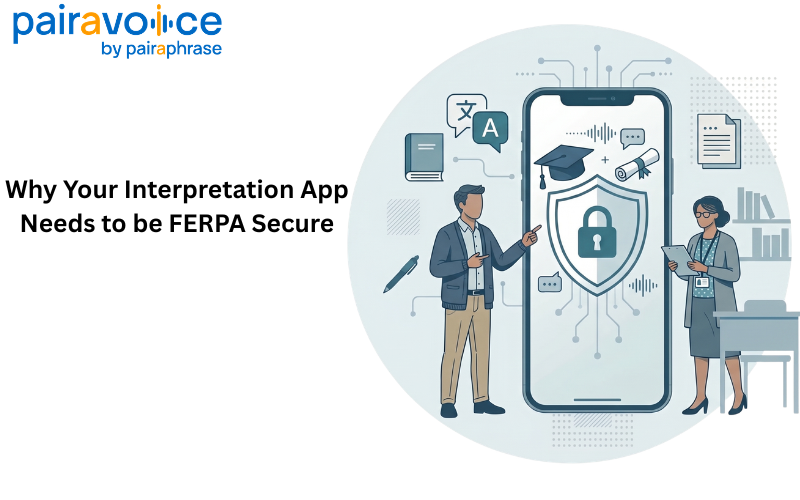
Schools need to evaluate their interpretation apps for FERPA alignment because everyday conversations with students and families may involve protected information from education records. Even when an app doesn't save a recording or transcript, it may still process sensitive student information. Understanding how that information is handled, who can access it, and whether the vendor's practices meet district requirements is essential to protecting student privacy.
In short: FERPA can be relevant when an AI interpretation app receives personally identifiable information (PII) from student education records or creates recordings or transcripts that qualify as education records. Schools should review the app's data handling, vendor agreement, and intended use before approving it for conversations involving protected student information.
What does FERPA mean for an interpretation app?
The Family Educational Rights and Privacy Act (FERPA) is a federal law protecting the privacy of student education records at educational agencies and institutions covered by the law. It gives parents and eligible students certain rights concerning those records and limits disclosures of personally identifiable information from them.
An education record is generally information directly related to a student that a school, or a party acting on its behalf, maintains. Records do not have to be written: audio and digital files can meet that definition. A live conversation does not automatically become an education record simply because a student is mentioned, but an app may process information from existing records or generate a student-related recording or transcript that the school maintains.
Think about the information that might come up during a multilingual school conversation:
- Grades, attendance, and classroom progress
- Behavior, discipline, or counseling-related information
- Special education services, accommodations, or IEP-related information
- Student health information maintained as part of school records
The key consideration is whether the information disclosed or created requires FERPA safeguards.
Why schools should look beyond a consumer translation app
Real-time AI interpretation often involves several steps: a service recognizes spoken words, translates them, and generates spoken or written output. Depending on the tool, different providers may handle these steps, and the app may also create a transcript or conversation history.
Before approving an app for student-related use, schools should look for four potential problems:
- Unclear processing: Staff cannot tell where conversation data goes or which providers receive it.
- Unclear retention: Audio and transcripts are saved longer than expected, or deletion options are undocumented.
- Uncontrolled access or sharing: Saved material can be viewed, exported, or reused outside approved school workflows.
- Secondary use: A vendor's terms allow data use beyond delivering the requested service, without appropriate school review.
The U.S. Department of Education advises teachers to check with school or district administrators before using online applications that may receive PII from education records.
How to evaluate a FERPA-secure interpretation app
FERPA does not provide an official certification for interpretation apps. District decision-makers should assess the technology, the intended use, and the vendor agreement.
1. Confirm what is processed and by whom
Ask whether the app sends live audio, recognized speech, translations, or transcripts to outside services. Request a clear description of subprocessors and the purposes for which each receives data. This matters even when a conversation is never saved to a user's library.
2. Review access, security, and device controls
Ask about encryption, authentication, access permissions, secure exports, and what happens if a staff device is lost. School approval should cover both the provider's safeguards and how staff will use the app.
3. Understand recording, retention, and deletion
Determine whether the app records by default, whether saved transcripts are optional, who can retrieve them, how long they are kept, and how deletion requests work. A transcript that is convenient for follow-up also creates another item the district may need to manage.
4. Check contracts and permitted data uses
When a vendor receives PII from education records under FERPA's school official exception, specific conditions apply. Among them, the school must exercise the required direct control over the use and maintenance of that information, and the provider must meet applicable use and redisclosure restrictions. Ask legal or privacy staff to review the agreement and any claims about AI training or other secondary use.
5. Test whether the workflow fits the conversation
Data protection does not guarantee accurate interpreting. Test the app with actual language pairs, everyday school terminology, background noise, and staff workflows. Set clear rules for when personnel should verify a translation or bring in a qualified human interpreter.
FERPA privacy and language access are separate responsibilities
FERPA addresses student record privacy. Schools also have obligations to communicate important school information effectively with parents who have limited English proficiency, including under Title VI. A privacy-conscious tool is only useful if families can also understand and participate in the conversation.
AI interpretation can be practical for many routine interactions, such as enrollment questions, scheduling, and general family follow-up. Formal IEP proceedings, disciplinary matters, and other high-stakes exchanges may require qualified interpreter assistance or additional review under applicable law and district policy. Schools should not assume an AI app alone satisfies every language-access requirement.
For more on everyday use cases, see How Schools Benefit From Interpreting Software.
How PairaVoice fits into school communication
PairaVoice is a mobile app for live, two-way multilingual conversations. It combines spoken interpretation with on-screen text and transcription capabilities, making it relevant to educators who need language support during everyday in-person interactions.
PairaVoice helps schools protect student privacy while overcoming language barriers. Conversations are never stored on PairaVoice servers without explicit permission, giving educators greater control over their conversation data. For schools that need to reference discussions later, PairaVoice Pro also offers saved, searchable transcripts and note-taking capabilities.
PairaVoice Pro is designed for FERPA-aligned educational use. Schools can explore PairaVoice's features, privacy practices, and support documentation to determine whether it fits their district's communication needs and approved workflows.
Explore PairaVoice for Schools
Review PairaVoice Privacy & Support
Frequently asked questions about FERPA and interpretation apps
Are interpretation apps officially FERPA certified?
No. FERPA does not establish a universal certification program for apps.
Can teachers use free translation apps during parent conferences?
They should follow district technology policies first. If the app receives PII from education records, the school needs to assess whether the disclosure and the provider's practices are permitted under FERPA.
Can an AI-generated transcript become an education record?
Yes. A transcript may qualify when it is directly related to a student and maintained by the school or a party acting on its behalf. Context matters; not every transcript automatically qualifies.
Can AI interpretation replace a human interpreter for IEP meetings?
Schools should not assume so. The appropriate assistance depends on the meeting, the family's needs, applicable legal requirements, and the risks of misunderstanding. Qualified human interpreting may be necessary, especially for complex decisions or formal proceedings.
Protect student privacy while keeping families connected
Choosing an interpretation app for schools means balancing accessible multilingual communication with student privacy. PairaVoice offers live, two-way interpretation for educators seeking a solution that fits their district's communication needs and approved workflows.
