

/PairaVoice-Start-A-Conversation-nobg-md.png?width=200&height=300&name=PairaVoice-Start-A-Conversation-nobg-md.png)


















.png)

.png)

 ChatGPT
 Google AI
 Perplexity
 Claude
 Grok
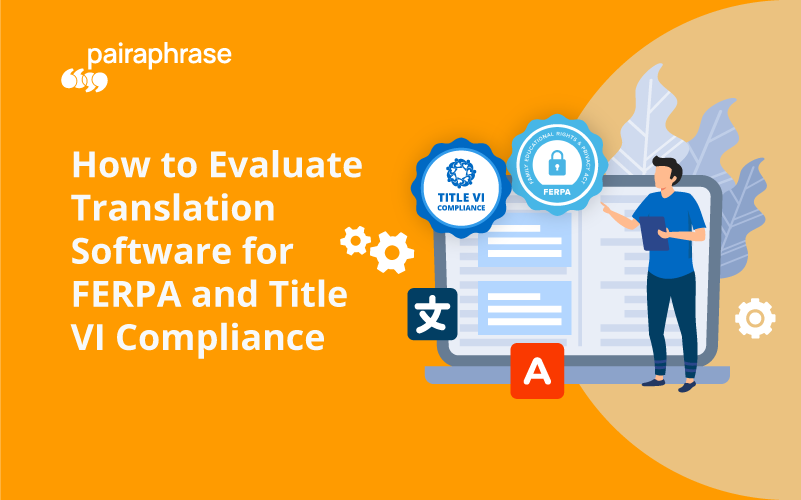
GrokAdopting translation software is not just a communications upgrade; it’s a compliance decision that directly affects FERPA data privacy requirements and Title VI language access requirements.
For district administrators, IT directors, compliance officers, and RFP writers, evaluating translation software for use in regulated environments means asking more than “Does it translate well?”
It means determining:
-
Does this translation tool protect student data?
-
Does it meet FERPA-compliant translation software standards?
-
Will it support Title VI compliance education requirements?
-
Can we defend this decision in a procurement review?
Here’s how to actually approach that vetting process internally.
Why trust our guidance on translation software for Title VI & FERPA
Translation software should be evaluated through privacy, civil rights, and procurement standards simultaneously.
Our team works with regulated organizations navigating FERPA data privacy requirements and Title VI language access obligations, giving us practical insight into how real compliance reviews unfold.
Why translation software is now a compliance decision, not just an access tool
Language access has always mattered. What has changed is the level of risk.
For instance, today, school translation services often touch:
-
Student records
-
Disciplinary communications
-
Parent communication translation workflows
-
Multilingual emergency notifications
Once student information enters a system, it becomes a student data privacy issue and not just an operational one.
Under FERPA data privacy requirements, districts are responsible for safeguarding personally identifiable information (PII). Under Title VI compliance education obligations, school districts must ensure meaningful language access for families with limited English proficiency.
That means translation software for school districts sits at the intersection of privacy law and civil rights compliance.
How school districts evaluate translation software
When districts review secure translation tools for schools, the evaluation typically runs through three core areas:
1. Data privacy and student records
IT and compliance teams should ask:
-
Does the software process or store student education records?
-
Is data encrypted in transit and at rest?
-
Where is the data hosted?
-
Does the vendor retain data to train AI models?
During the education vendor vetting process, districts often require documentation explaining exactly how student information is handled. If translation software for education retains or repurposes data without clarity, it’s usually flagged immediately.
2. Access controls and permissions
District IT directors typically examine:
- Role-based access controls
- Multi-factor authentication options
- Audit logs
- Administrator visibility
FERPA-compliant translation software must allow districts to restrict access to, upload, or download student-related content.
In many districts, translation software must align with broader school district procurement software policies, meaning it must integrate with existing permission structures—not bypass them.
3. Storage, retention, and third-party access
One of the most common approval delays happens here.
Districts want clear answers to:
-
How long is translated content stored?
-
Who owns the data?
-
Can the district delete it on demand?
-
Are subcontractors or third-party APIs involved?
Compliance review translation tools are expected to provide transparent documentation. If vendors cannot clearly explain retention policies or third-party access, legal teams often pause the process.
FERPA considerations districts look for in translation software
When reviewing translation software for school districts, compliance teams focus on how the tool handles education records — not just how well it translates.
FERPA-compliant translation software should:
-
Protect personally identifiable information from unauthorized disclosure
-
Clearly define data ownership
-
Allow districts to control access and deletion
-
Provide written security documentation
If translation software for education stores student information in ways that conflict with FERPA data privacy requirements, districts risk non-compliance — even if the translation quality is excellent.
That’s why student data privacy translation safeguards often carry more weight than feature lists during vendor selection.
Title VI requirements that affect software selection
Title VI language access requirements for schools are not optional, and software plays a direct role in how districts meet that obligation. Title VI compliance education standards require districts to provide meaningful access for families with Limited English proficiency (LEP).
Schools must ensure that language access services are effective, timely, and equitable, which directly influences how translation software for school districts is evaluated. In practice, that means:
-
Timely translation
-
Consistent communication
-
Accuracy across multiple languages
-
Equitable access to information
School translation software is evaluated on its ability to support these outcomes at scale.
If workflows are inconsistent, languages are limited, or translation delays create communication gaps, schools and education institutions may face language access compliance audits or complaints.
In short: tooling affects compliance outcomes.
Common red flags that delay or block approval
During the education vendor vetting process, these issues frequently slow or stop approval:
-
Unclear data ownership terms
-
No confirmation of FERPA-compliant process
-
Lack of role-based access controls
-
Vendor uses data to train external AI systems without opt-out
-
No clear retention or deletion policy
-
Limited language support that undermines Title VI compliance education goals
-
Poor integration with the existing procurement software
Even strong translation engines can fail district review if governance controls aren’t clear.
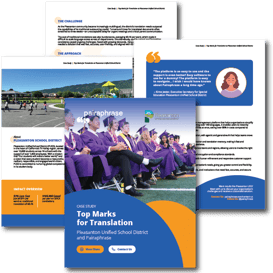
See how Pleasanton Unified School District improved multilingual communication and saved $186,000.
Explore the case study to learn how the district streamlined translation workflows, strengthened parent engagement, and implemented secure translation processes at scale.
FAQ
How do school districts evaluate translation software for FERPA compliance?
School districts evaluate translation software for FERPA compliance by reviewing how the system handles student data, including access controls, storage practices, and encryption standards. The translation provider must be willing to sign a FERPA-specific service agreement.
They also assess whether personally identifiable information is protected from unauthorized disclosure.
Does FERPA apply to translation and interpretation software?
Yes, FERPA applies to translation and interpretation software that processes or stores student education records or personally identifiable information, which must comply with FERPA data privacy requirements.
What role does Title VI play in selecting translation software for schools?
Title VI plays a direct role in selecting translation software for schools, as districts must provide meaningful language access, which shapes how software is evaluated for accuracy, consistency, and multilingual accessibility.
Why do school districts involve IT and legal teams in translation software decisions?
School districts involve IT and legal teams in translation software decisions because these tools may access student records and parent communications, creating privacy, security, and compliance risks that require formal review.
What are the common reasons translation software fails district approval?
Translation software commonly fails district approval due to unclear data ownership, lack of access controls, insufficient security documentation, weak retention policies, or workflows that do not align with FERPA and Title VI requirements.
Recommended Translation Software for Title VI and FERPA Compliance
Want to get started with the best translation software for Title VI and FERPA compliance? Use Pairaphrase. It’s the AI Translation Management System for teams that value smarter, faster, and safer translation.

Pairaphrase supports 160+ languages and 27,000+ language pairs. Translate into Spanish, English, French, German, Arabic, Hindi, Chinese, Japanese, and more. Not to mention, Pairaphrase performs file translation for 25+ file types.
Just one translation with Pairaphrase can cover your annual subscription!
Get Started
Schedule a demo or share this article with a colleague.
"Pairaphrase has been a game-changer for us. We can provide translated documents to our parents in a matter of minutes instead of days or weeks."
- Carla McCluskey, Executive Secretary @ Dayton Public Schools

Reviewed by

Founder and CTO
He is Co-Founder and CTO of Pairaphrase and a leader in translation technology with more than two decades of experience improving how organizations communicate across languages. His work focuses on making multilingual communication more accurate, efficient, and accessible through AI-driven translation solutions, practical innovation, and a strong emphasis on usability, quality, and security.